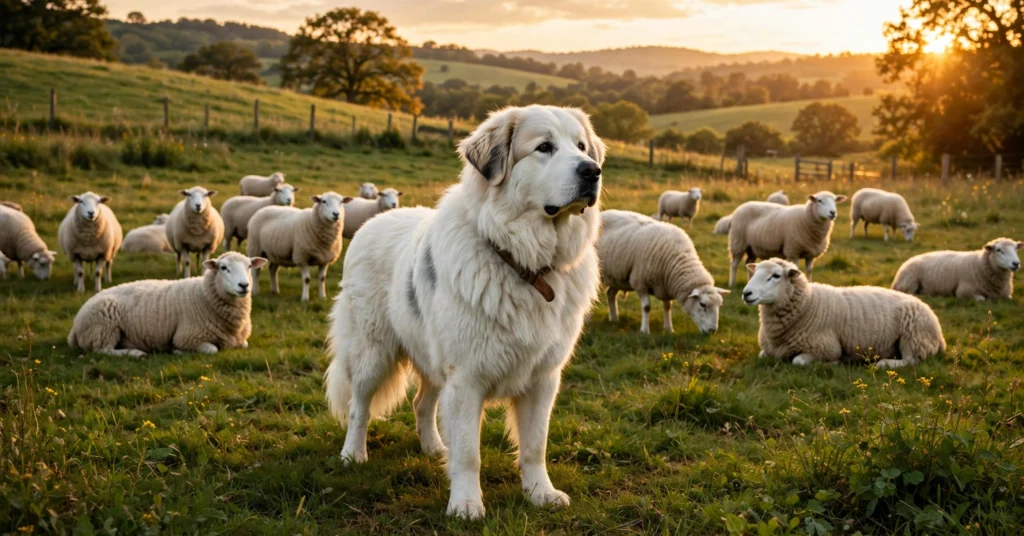
For thousands of years, one type of dog has done a job no fence or alarm can do.
They live with sheep. They sleep in the snow. And when wolves come in the night, they stand their ground.
Livestock guardian dog breeds are the oldest working dogs on earth. This guide covers the 10 best breeds, how they work, and the honest truth about living with one.
Quick Answer: Best Livestock Guardian Dog Breeds
Short on time? Here are the top picks.
Best for beginners: Great Pyrenees. Gentle, forgiving, and the most common in the USA.
Best for hot climates: Anatolian Shepherd. Lean, fast, and handles heat well.
Best for small farms: Maremma Sheepdog. Stays close to stock and wanders less.
Best against wolves: Kangal. Bred for centuries to face down apex predators.
Keep reading for all 10 breeds plus the real costs of owning a guardian.
📋 Contents (click to open)
What Are Livestock Guardian Dog Breeds?
Livestock guardian dogs are not herding dogs. That is the first thing to understand.
A Border Collie moves sheep. A livestock guardian dog becomes part of the flock. They live with the animals 24 hours a day. They bond with sheep and goats like family.
When a predator approaches, the guardian places itself between the threat and the flock. Most of the time, barking and size are enough. These dogs rarely need to fight.
Guardian vs Herder: Key Difference
Guardians protect. Herders move.
Guardians work independently and make their own decisions. Herders take commands from a shepherd. This independence is the hardest part of owning a guardian breed.
These breeds developed over thousands of years across Europe and Asia. Each one adapted to local predators, climate, and livestock.
10 Best Livestock Guardian Dog Breeds
1. Great Pyrenees
The most popular livestock guardian dog breed in America. And the most forgiving for new owners.
Size: 85 to 160 pounds. Best for: Sheep, goats, families.
Calm, patient, and famously good with children. The downside? They bark all night and roam farther than any other guardian breed. Your fence will be tested.
2. Anatolian Shepherd
Leaner and more serious than the Pyrenees. A true working dog with no interest in being a pet.
Size: 110 to 150 pounds. Best for: Hot climates, large ranges.
Handles heat better than any other guardian. Covers huge territory. Harder with strangers, so better for remote farms than busy homesteads.
3. Maremma Sheepdog
Italy’s answer to the Pyrenees. Slightly smaller and more likely to stay with the flock.
Size: 75 to 100 pounds. Best for: Poultry, goats, small farms.
Less prone to wandering. A smart middle ground between the soft Pyrenees and the sharp Anatolian.
4. Kangal
The legendary Turkish guardian. Bred for centuries to face wolves alone.
Size: 110 to 145 pounds. Best for: Serious predator pressure.
Calm, controlled, and incredibly powerful. Not a beginner dog. Needs a job and a confident owner.
5. Akbash
Another Turkish breed. White coat, athletic build, and sharp instincts.
Size: 90 to 140 pounds. Best for: Open range, sheep and goats.
Similar to the Kangal but slightly more agile. Bonds deeply with stock. Can be wary of strangers.
6. Komondor
The Hungarian mop dog. Those cords are not just for looks. They protect against bites and cold.
Size: 80 to 130 pounds. Best for: Sheep, experienced owners.
Fiercely loyal and independent. The coat needs serious maintenance. Not for casual owners.
7. Kuvasz
Hungary’s other guardian. Elegant, white, and brave.
Size: 70 to 115 pounds. Best for: Experienced owners, property guarding.
More sensitive than most guardians. Bonds hard with one family. Slow to trust strangers.
8. Tibetan Mastiff
An ancient Himalayan guardian. Massive, aloof, and independent.
Size: 90 to 160 pounds. Best for: Experienced owners only.
Nocturnal by nature. Sleeps all day, patrols all night. Extremely stubborn. This is not a starter guardian.
9. Spanish Mastiff
Spain’s gentle giant. Bred to guard migrating sheep across huge distances.
Size: 140 to 220 pounds. Best for: Large properties, cattle.
Surprisingly calm and sweet with family. The sheer size handles most threats by presence alone.
10. Caucasian Shepherd
The most extreme guardian on this list. Bred to fight wolves and bears in the Caucasus mountains.
Size: 130 to 220 pounds. Best for: Experts facing large predators.
Immensely powerful and deeply suspicious of strangers. I cannot stress this enough. Only for highly experienced owners with serious predator problems.
Livestock Guardian Dog Breeds: Comparison Table
| Breed | Weight | Best Climate | Beginner Friendly |
|---|---|---|---|
| Great Pyrenees | 85-160 lbs | Cold to moderate | Yes |
| Anatolian Shepherd | 110-150 lbs | Hot | Somewhat |
| Maremma Sheepdog | 75-100 lbs | Moderate | Yes |
| Kangal | 110-145 lbs | Hot to moderate | No |
| Akbash | 90-140 lbs | Moderate | Somewhat |
| Komondor | 80-130 lbs | Cold | No |
| Spanish Mastiff | 140-220 lbs | Moderate | Somewhat |
| Caucasian Shepherd | 130-220 lbs | Cold | No |
The Honest Truth About Owning One
I have trained several guardian breeds. Here is what nobody tells you before you get one.
They Bark. All Night.
Guardians bark to warn predators away. Most of this happens between midnight and 4 AM. If you have close neighbors, think hard about this.
They Roam
A guardian decides where its territory ends. That decision may include your neighbor’s farm. Tall, secure fencing is not optional.
They Think for Themselves
You cannot obedience-train the independence out of a guardian. They were bred to make life-or-death decisions alone. Respect that or choose a different breed.
They Shed. A Lot.
Most guardians have thick double coats. Twice a year, your house will look like it snowed indoors.
My advice: Start with a Great Pyrenees or Maremma if you are new to guardians. Get the puppy from working parents on a real farm. And budget for fencing before you budget for the dog.
Training a Livestock Guardian Dog
Forget everything you know about obedience training. Guardians learn differently.
Start at 7 to 8 weeks old. The puppy should live with the livestock from day one. Bonding with the flock matters more than any command.
Keep training sessions short. Use rewards, never force. A guardian that fears you will not trust your judgment.
Socialize with people too. A guardian that has never met a stranger may treat your veterinarian like a wolf. Early, positive exposure to visitors prevents dangerous overreactions later.
For breed details and standards, the AKC Great Pyrenees breed page covers the most popular guardian breed in the USA. For vet-reviewed breed guidance, PetMD’s Great Pyrenees guide breaks down temperament, health, and daily care.
Conclusion
Livestock guardian dog breeds are remarkable animals. They ask for little and give everything.
But they are not pets that happen to guard. They are guardians that happen to live with you. If you have livestock, predators, and space, a guardian will change your farm life. If you want a cuddly companion, get a retriever.
Choose the breed that fits your climate, your predators, and your experience level. Then give the dog a job and let it work.
Related Guides
- Smartest Dog Breeds: 15 Genius Pups Ranked (2026)
- Police Dog Breeds: 10 Elite K9 Breeds and Their Roles
- Large Dog Breeds: 15 Best Big Dogs for Families (2026)
- Newfoundland Dog: Complete Guide
- Australian Shepherd Puppy Guide: Raise a Calm, Happy Aussie
- Border Collie Puppy: The Complete Genius Puppy Manual
- German Shepherd Puppy: Complete First Year Guide (2026)
- Best Dog Breeds for Families: 12 Kid-Friendly Picks for Every Home (2026)
Frequently Asked Questions
What is the best livestock guardian dog breed?
The Great Pyrenees is the best choice for most people. It is the most common in the USA, the most forgiving for beginners, and famously gentle with families. For hot climates, the Anatolian Shepherd is better. For serious wolf pressure, the Kangal is the top pick.
Can livestock guardian dogs live as family pets?
Yes, many do. Great Pyrenees and Maremmas especially adapt well to family life. They are calm indoors and devoted to children. But they keep their barking, roaming instincts, and independence, so they need space and secure fencing.
How much does a livestock guardian dog cost?
A puppy from working parents typically costs $300 to $800. Rescues and rehomed adults can be cheaper or free. Remember that fencing, food for a giant breed, and vet care cost far more than the purchase price.
Do livestock guardian dogs need training?
Yes. While guarding instinct is natural, puppies need early bonding with livestock (starting at 7-8 weeks), basic manners, and socialization with people. Training should be short, patient, and reward-based. Force does not work on independent guardians.
Will a livestock guardian dog kill predators?
Rarely. Most guardians deter predators through barking, scent marking, and sheer presence. Physical fights are uncommon. A good guardian prevents conflict rather than seeking it.
What is the difference between a livestock guardian and a herding dog?
Guardians protect livestock by living with them and deterring predators. Herders move livestock under a shepherd’s direction. Guardians work independently; herders take commands. They are completely different jobs requiring different temperaments.