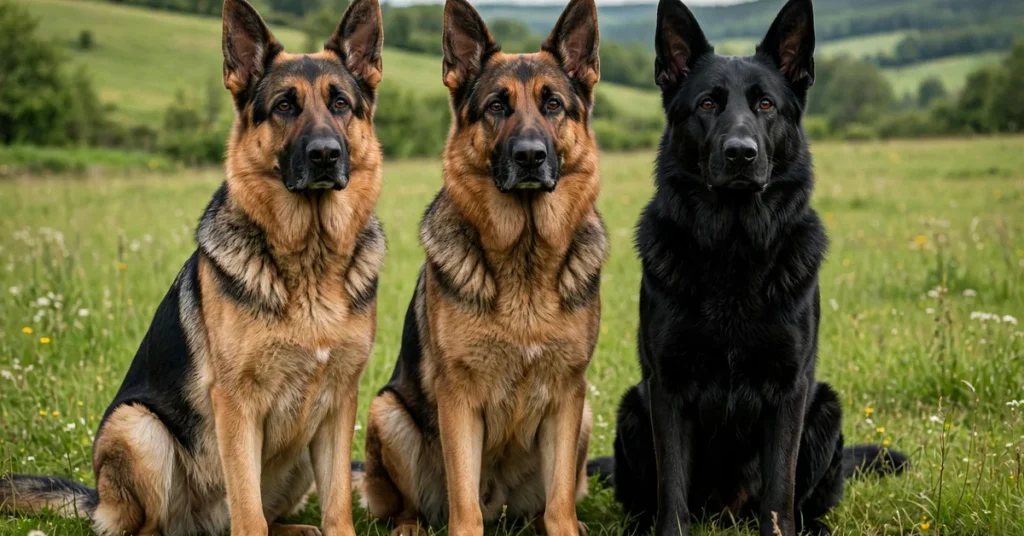
Picture three German Shepherds standing side by side in a sunny meadow. One wears the classic black and tan saddle, one glows with a wild wolf-like sable coat, and one is black from nose to tail like a living shadow. Same breed, same noble heart, totally different look. That variety is what makes german shepherd colors such a fun topic, and such a confusing one for new owners.
Some colors win trophies in the show ring. Others get turned away at the gate even though the dog underneath is every bit as smart and loyal. And a few rare shades come with eye-watering price tags. In this guide I will walk you through all nine shades, what the AKC actually says, which myths are nonsense, and how to choose a puppy for the right reasons.
Quick Answer
The full list of german shepherd colors includes five AKC recognized shades (black and tan, black and red, sable, solid black, and bi-color) and four shades the AKC does not accept for the show ring (solid white, gray or blue, liver, and panda). Color has zero proven effect on temperament or intelligence. What actually matters is health testing, early socialization, and consistent training. If you want the short version, pick the breeder first and the color second.
📋 Contents (click to open)
AKC Recognized German Shepherd Colors
The American Kennel Club breed standard accepts quite a few shades, as long as the color is rich and the pattern is clear. The AKC’s official German Shepherd page describes the breed in full, and the standard itself favors strong, saturated color over any single pattern. Here are the five shades you will see most often, in the ring and on the street.
Black and Tan
This is the look most people picture when they hear the breed’s name. A black saddle drapes over the back while rich tan covers the legs, chest, and face. Think of the classic movie dogs and most show line Shepherds on television.
It is also the most common color at the dog park. The pattern stays crisp with age, and puppies are easy to find. If you want the iconic German Shepherd look, this is it.
Black and Red
Take black and tan and turn up the volume. The tan deepens into a rich mahogany red that looks stunning in sunlight. This shade dominates the modern show ring, especially in West German show lines, where breeders have selected for deeper red pigment for decades.
One thing to know. That deep red usually softens a little as the dog ages. A fiery red puppy often matures into a gentler red adult, which is completely normal.
Sable
Sable is the wild one. Each hair carries bands of different colors, usually tan or gray with black tips, giving a wolf-like look that shifts in the light. No two sable dogs look exactly alike.
Here is my favorite fact. Sable was the color of Horand von Grafrath, the first registered German Shepherd in 1899. It is literally the original. The gene is dominant, which is why sable stays so common in working and police lines.
Solid Black
No saddle, no tan points, just black from nose to tail. Solid black Shepherds look like panthers and turn heads everywhere. The color comes from a recessive gene, so both parents must carry it for a black puppy to appear.
You will see solid blacks most often in working lines, where police and sport breeders value the strong stock behind them. Fair warning, black hair shows up dramatically on a light colored couch.
Bi Color
Bi color dogs are mostly black with small tan markings, usually on the lower legs, a dot above each eye, and sometimes under the tail. Many people mistake them for solid blacks until they spot the tan eyebrows.
This pattern is common in working lines and rare in the show ring. If you want a mostly black dog with extra character, bi color is a wonderful middle ground.
Colors the AKC Does Not Recognize
Beyond the show ring, german shepherd colors get wilder and, honestly, more interesting. These four shades can still be registered in many cases, but white is a disqualifying fault in AKC conformation shows and the dilute and panda shades fall outside the standard. That says nothing about the dog as a pet, a worker, or a family member.
Solid White
White German Shepherds are breathtaking, and they were once common in the breed’s herding lines. The American standard was later changed to disqualify white from conformation, which pushed white dogs into their own dedicated breeding community. Europe’s FCI now recognizes them as a separate breed, the White Swiss Shepherd.
Now the myth busting. In some breeds white coats link to deafness, but no such link has been proven in German Shepherds. A white puppy from health tested parents is just as sound as any other color, and they shine in obedience and agility.
Gray (Blue)
Blue is a diluted black. A dilution gene washes the black pigment to a smoky gray or steel blue, sometimes with a matching gray nose. These dogs look almost ghostly and gather crowds at the park.
Here is the honest health note. Dilute dogs of many breeds can develop color dilution alopecia, a skin condition causing thinning hair and flaky skin. Not every blue dog gets it, but the risk is real. Ask the breeder about coat and skin history in their lines.
Liver
Liver turns all the black pigment brown, like melted chocolate, with a brown nose, brown paw pads, and often striking amber eyes. Photos barely do it justice.
Liver comes from a recessive gene, so it can pop up unexpectedly in a litter of normally colored parents. It is rare because few breeders select for it, not because anything is wrong with it.
Panda
Panda is the rarest pattern of all. Bold white markings, a white blaze, collar, legs, and tail tip, sit over a normal black and tan or sable base. The pattern traces to a spontaneous piebald mutation in a single bloodline.
Because the gene pool is tiny, I urge extra caution. A small gene pool leaves less room to breed away from health problems. Any panda breeder should show full health testing and lead with the pedigree, not the price tag.
| Coat Shade | AKC Recognized? | Rarity | Typical Price Note |
|---|---|---|---|
| Black and Tan | Yes | Very common | Standard range, widely available |
| Black and Red | Yes | Common | Standard range, show lines may cost more |
| Sable | Yes | Common | Standard range, working lines typical |
| Solid Black | Yes | Less common | Standard range, recessive gene |
| Bi Color | Yes | Less common | Standard range, mostly working lines |
| Solid White | No, disqualified | Uncommon | Specialty breeders, moderate markup possible |
| Gray (Blue) | No | Rare | Rare color markup common, ask about skin health |
| Liver | No | Rare | Rare color markup common |
| Panda | No | Very rare | Highest markup, verify tiny gene pool health |
The Story Behind Color Preferences
The story of german shepherd colors starts in 1899 with a dog named Horand von Grafrath, the first registered German Shepherd. He was a gray-yellow sable with a dark overlay. So the breed’s founding color was not black and tan at all. It was the wolfish sable you still see in police K9 units today.
So how did black and tan become iconic. The show world happened. Through the 1900s, judges and breeders favored the dramatic saddle pattern, refining it into the deep black and red winning trophies today. Working breeders kept selecting for courage, nose, and drive instead, so sable, solid black, and bi color stayed dominant in working lines.
White dogs have their own chapter. They worked sheep in early herding lines, and old photos prove it. When the American standard later disqualified white, dedicated fanciers kept breeding them anyway, eventually producing the White Swiss Shepherd as its own European breed. Show fashion and breed history do not always agree.
Does Coat Color Affect Health or Temperament?
Short answer, no, not in the way most people think. In eight years and more than 300 family dogs trained, I have worked with black and tans, sables, solid blacks, whites, and blues, and the coat told me nothing about the brain inside the skull. Research backs this up. PetMD’s German Shepherd guide notes that breed itself accounts for only about 9 percent of a dog’s behavior, with the individual dog and its training mattering far more. If breed barely predicts behavior, coat color predicts essentially nothing.
Myth one, white Shepherds are sickly or deaf. In a few breeds extreme white links to deafness, which is where this rumor started. No such link has been established in German Shepherds. A white puppy from tested parents has the same outlook as its black and tan littermates.
Myth two, solid black Shepherds are more aggressive. This is pure folklore, probably because a big black dog looks intimidating. I have trained marshmallow soft black Shepherds and intense black and tans. Aggression comes from genetics, poor socialization, and fear, not pigment.
Myth three, rare colors are always unhealthy. Not always, but one exception is real. Dilute colors like blue and gray carry a documented risk of color dilution alopecia, which causes hair thinning and skin trouble. Panda’s tiny gene pool is a separate legitimate concern. Everything else is just color.
The real health drivers never change. Hip and elbow screening, degenerative myelopathy testing, and a breeder who proves it with paperwork. Those matter a thousand times more than shade.
What Do These Colors Cost?
Here is the honest truth about german shepherd colors and money. A well bred puppy from fully health tested parents typically costs 2,000 to 4,000 dollars in the United States, regardless of shade. That range reflects health testing, titling, and quality raising, not the coat.
For the five recognized colors, expect that standard range. You are paying for the breeder’s program, not the pigment.
Rare shades are where pricing gets spicy. Panda, blue, and solid white puppies from specialty breeders sometimes carry a rare color markup, occasionally reaching 4,000 to 6,000 dollars or more. Be skeptical of the markup. A high price should buy you OFA hips and elbows, DM results, and a breeder who interviews you as hard as you interview them.
Watch for this red flag. Any breeder whose main selling point is the shade, with phrases like rare blue puppies act fast, is selling a trend. Great breeders talk temperament, health clearances, and which puppy fits your life. Color comes up around question ten, not question one.
How to Pick a Color the Right Way
When buyers fixate on german shepherd colors, some breeders start breeding for shade instead of soundness. That is how real problems creep in. Tiny gene pools, skipped health tests, and puppies priced like handbags. The good news is that avoiding all of it is simple.
Step one, choose the breeder before the color. Look for full health testing, titled dogs, and a home where dogs clearly live as family. A great breeder is picky about you, and that is exactly what you want.
Step two, meet the parents if you can. Temperament is strongly heritable. A calm, confident mother tells you more about your future puppy than any coat shade.
Step three, put color third. The right puppy in black and tan beats the wrong puppy in your dream color every time. Families fall in love with the puppy they did not plan on more often than you would think.
Step four, consider rescue. Gorgeous sables, black and tans, and even whites wait in shelters and breed rescues for a fraction of breeder prices. An adult rescue shows you the finished temperament, no guessing required.
Ask about health testing before you ask about colors. The order of your questions tells the breeder what you value.
Conclusion
At the end of the day, german shepherd colors are the wrapping paper, not the gift. Nine shades, five for the show ring and four for the rest of us, and every one of them can grow into a brilliant, loyal, slightly dramatic family dog with the right training and love.
Pick a breeder who health tests. Pick a puppy whose temperament fits your life. Then enjoy whichever gorgeous coat comes with the package. My Lab Cooper would like me to add that black dogs photograph terribly and he is still perfect. Coats fade a little with age anyway. Character does not.
Related Guides
- The Alsatian Dog: 7 Powerful Facts & Breed History (2026)
- How Long Do German Shepherds Live? 9 Proven Tips (2026)
- German Shepherd Puppy: Complete First Year Guide (2026)
- Police Dog Breeds: 10 Elite K9 Breeds and Their Roles
- Guard Dog Breeds: 10 Best Protectors for Families (2026)
- Smartest Dog Breeds: 15 Genius Pups Ranked (2026)
- Large Dog Breeds: 15 Best Big Dogs for Families (2026)
- Black Lab Guide 2026: 15 Secrets Every Owner Must Know
Frequently Asked Questions
What is the rarest German Shepherd color?
The panda pattern is the rarest German Shepherd color. It comes from a spontaneous piebald mutation found in a single bloodline, so only a small number of dogs carry it. Rarity does not mean better, and the tiny gene pool deserves extra caution around health testing.
Are white German Shepherds recognized by the AKC?
White German Shepherds can be AKC registered, but white is a disqualifying fault in AKC conformation shows. They can still compete in performance sports like obedience and agility. In Europe the FCI recognizes white dogs as a separate breed called the White Swiss Shepherd.
What is the most common German Shepherd color?
Black and tan is the most common German Shepherd color. The classic saddle pattern is what most people picture when they think of the breed, and it is the easiest shade to find from both show line and pet breeders.
Do black German Shepherds have more health problems?
No. Solid black is simply a recessive coat gene and carries no extra health risk on its own. Black Shepherds need the same health screening as every other color, including hip and elbow evaluations and degenerative myelopathy testing.
What is a sable German Shepherd?
A sable German Shepherd has individual hairs banded with multiple colors, usually tan or gray with black tips, giving a wolf-like look. Sable was the color of Horand von Grafrath, the first registered German Shepherd in 1899, and it remains very common in working and police lines.
Are blue German Shepherds healthy?
Blue, or gray, German Shepherds can be healthy, but the dilution gene behind the color carries a real risk of color dilution alopecia, a skin condition that causes hair thinning. Not every blue dog develops it. Ask the breeder about coat and skin history in their lines before committing.