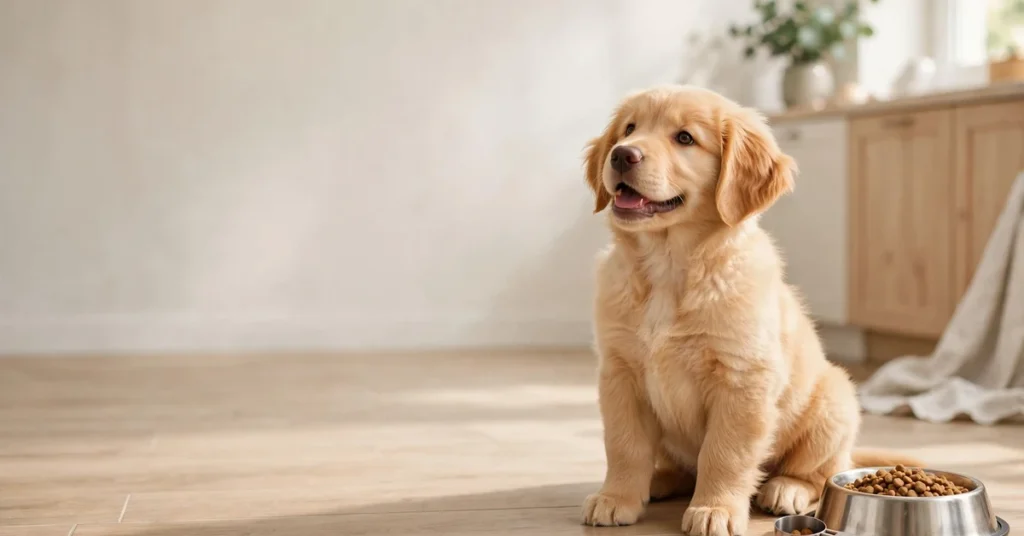
Your puppy looks up with big round eyes, and one question circles your mind: how much to feed a puppy? Too little can slow healthy growth. Too much can stress tiny growing joints.
Good news: feeding a puppy is not guesswork. With a simple chart, a real measuring cup, and the easy rib test below, you can fill that bowl with total confidence.
Quick Answer
Serve 3 to 4 small meals a day until 6 months old, then drop to 2 meals a day. Start with the chart on your food bag, then adjust for age and expected adult size. The golden rule: watch your puppy’s body, not the bowl. Ribs you can feel but cannot see mean the amount is just right.
📋 Contents (click to open)
How Much to Feed a Puppy by Age
Puppies burn far more calories per pound than adult dogs because they are building new bone, muscle, and brain tissue every single day. That is why the number of meals matters as much as the amount. Here is the classic vet trusted schedule, backed by the AKC’s puppy feeding fundamentals guide:
- 6 to 12 weeks: 4 meals a day. Tiny stomachs need small frequent meals.
- 3 to 6 months: 3 meals a day. Growth is at its fastest during these months.
- 6 to 12 months: 2 meals a day. Growth slows toward adult size.
These are starting points. Active pups may need a bit more, calm pups a bit less. The rib test below shows you how to adjust.
How Much to Feed a Puppy by Breed Size
A Chihuahua and a Great Dane are both puppies, but breed size changes the feeding math.
Small Breeds (Adult Weight Under 20 Pounds)
Small breeds grow fast and often reach adult size by 9 to 12 months. Their speedy metabolism burns more calories per pound. They can usually switch to adult food at 7 to 9 months. Typical daily total: 1/2 to 1 1/4 cups.
Medium Breeds (Adult Weight 20 to 50 Pounds)
Medium puppies reach full size in about 12 to 15 months. Typical daily total: 1 1/2 to 2 1/2 cups.
Large and Giant Breeds (Adult Weight Over 50 Pounds)
Big puppies grow until 18 to 24 months and must grow slowly and steadily. Growing too fast raises the risk of bone and joint problems. Use a large breed puppy formula, which controls calcium and calories. Typical daily total: 2 1/2 to 4 cups.
Puppy Feeding Chart: Meals and Portions
Pin this chart to your fridge.
| Puppy Age | Meals Per Day | Daily Food (Typical Total) | What to Watch For |
|---|---|---|---|
| 6 to 12 weeks | 4 | 1/2 to 1 1/2 cups | Tiny stomach, needs frequent small meals |
| 3 to 6 months | 3 | 1 to 3 cups | Fastest growth phase, check the ribs weekly |
| 6 to 12 months | 2 | 1 1/2 to 4 cups | Growth slows, cut back if the waistline fades |
| 12 months and up | 2 | Follow adult food chart | Small breeds switch earlier, large breeds later |
The daily total rises as your puppy grows, then levels off. Leftovers often mean it is time to drop a meal or trim portions.
How Many Meals Per Day
Set meals beat leaving food out all day. Free feeding makes overeating easy and hides appetite changes that can signal illness.
- Serve meals at the same times daily. Routine also helps house training.
- Put the bowl down for 15 to 20 minutes, then pick it up.
- Split the daily total evenly. Two cups a day over 4 meals means 1/2 cup per meal.
- Keep fresh water out all day. Food gets a schedule, water does not.
Measuring Cups Beat Guessing
This is where most puppy parents go wrong. They scoop with a coffee mug or pour until it looks right. Guessing is the number one cause of accidental overfeeding.
- Use a real 8 ounce measuring cup, leveled flat.
- Use the same scoop every time.
- For top accuracy, weigh food in grams with a cheap kitchen scale.
An extra half cup a day looks small, but over a month it adds up. Two minutes with a measuring cup is the cheapest health insurance you can buy.
The Ask the Ribs Test
Your puppy’s body is the most honest feeding guide you own. Vets call this the body condition score. The VCA’s guide on how much food to feed a puppy shows exactly what to check.
Step 1: Feel the Ribs
Run your fingers across the rib cage. You should feel the ribs easily under a thin layer of fat, without pressing hard. Ribs you cannot feel usually mean smaller portions are needed.
Step 2: Check the Waistline
Look down from above. You should see a waist curving in behind the rib cage. A straight tube from shoulders to hips means extra padding.
Step 3: Look from the Side
The tummy should tuck up behind the ribs, not sag down. A saggy belly on a puppy older than 12 weeks is a sign the portions are too generous.
Treats and Training Snacks
Treats count as food. The vet rule: treats should stay under 10% of daily calories. For a puppy eating 400 calories a day, that is only 40 treat calories.
- Keep training treats tiny. Pea sized beats big chunks.
- On heavy training days, serve slightly smaller meals.
- Pick low calorie rewards: carrot, apple, or green bean pieces.
Conclusion
So, how much to feed a puppy? Start with the chart, measure every meal, and let your puppy’s body be the judge. Feel the ribs, check the waist, and watch the energy. Weigh weekly, and bring questions to every vet checkup. You are doing great just by asking.
Quick answers to the questions puppy parents ask me most often.
Related Guides
- Puppy Vaccine Schedule: What Happens at Every Visit (2026)
- Best Puppy Food: 7 Smart Label Checks Before You Buy (2026)
- German Shepherd Puppy: Complete First Year Guide (2026)
- Dog Treats: 9 Healthy Picks Every Dog Owner Must Try (2026)
- What Can Dogs Eat? 50+ Safe Foods and 15 Dangerous Ones (2026)
- Can Dogs Have Cheese? 7 Safe Types and 3 to Avoid (2026)
- Allergy-Friendly Dog Food Guide: 7 Vet-Backed Tips (2026)
- Best Dog Foods for Sensitive Stomach: 10 Gentle Picks That Actually Help (2026)
Frequently Asked Questions
How much should I feed my 8 week old puppy?
At 8 weeks old, feed your puppy 4 small meals a day. A typical daily total is 1/2 to 1 cup of puppy food, split evenly across the meals. Start with the feeding chart on your food bag, then adjust based on your puppy’s body condition. You should be able to feel the ribs under a thin layer of fat.
How many times a day should I feed my puppy?
Feed 4 meals a day from 6 to 12 weeks, 3 meals a day from 3 to 6 months, and 2 meals a day from 6 months onward. Serve meals at regular times and pick up the bowl after 15 to 20 minutes. Most puppies stay on 2 meals a day as adults.
How do I know if I am feeding my puppy enough?
Use the rib test. You should feel your puppy’s ribs easily without pressing hard, see a waistline from above, and see a tucked tummy from the side. If the ribs stick out visibly, increase the food a little. If you cannot feel the ribs at all, reduce the portions slightly.
Can I leave food out all day for my puppy?
It is better to use set meal times instead of free feeding. Leaving food out all day makes overeating easy and hides appetite changes that can signal illness. Scheduled meals also help with house training and teach healthy eating habits.
When should I switch my puppy to two meals a day?
Most puppies are ready for 2 meals a day at around 6 months old. Signs of readiness include losing interest in the midday meal or leaving food in the bowl. Large and giant breed puppies may benefit from staying on 3 meals a day a little longer, so check with your vet.
Do small breed puppies need more or less food than large breed puppies?
Small breed puppies need less total food but more calories per pound of body weight because of their fast metabolism. They also finish growing sooner and can switch to adult food at 7 to 9 months. Large breed puppies eat more total food, grow until 18 to 24 months, and need a large breed puppy formula for healthy joint development.