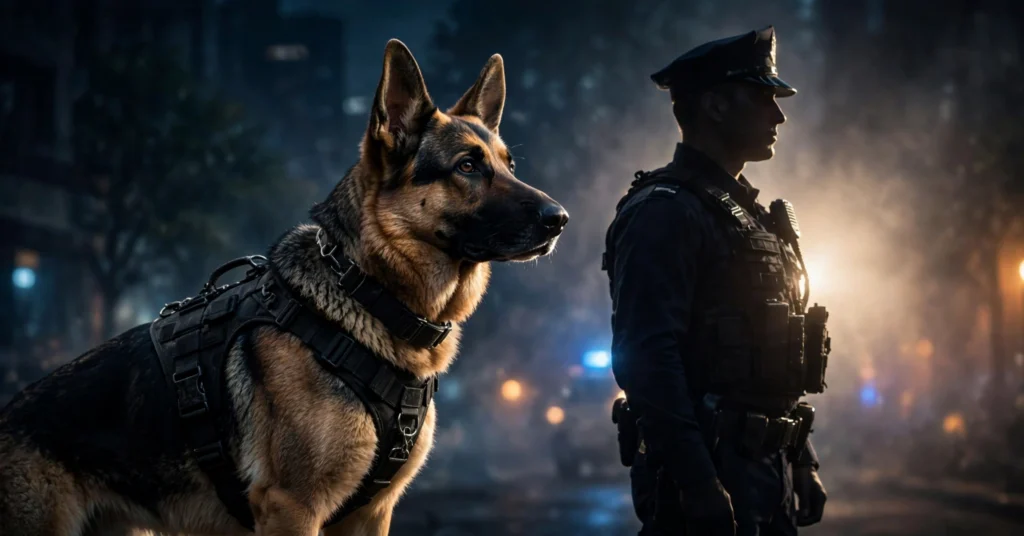
What does it take for a dog to earn a badge?
Not every tough-looking dog can do police work. In fact, most wash out. The selection is brutal, the training takes months, and only a handful of breeds make the cut.
Police dog breeds are the elite athletes of the dog world. This guide covers the top K9 breeds, what each one does best, and why your neighbor’s German Shepherd probably could not pass the test.
Quick Answer: Best Police Dog Breeds
Short on time? Here are the stars of the K9 world.
Best all-rounder: German Shepherd. Patrol, detection, tracking. Does it all.
Fastest growing in military K9: Belgian Malinois. Lighter, faster, and endlessly driven.
Best detection dog: Labrador Retriever. Friendly nose that finds drugs and explosives.
Best tracker: Bloodhound. 300 million scent receptors. Evidence that holds up in court.
Keep reading for all 10 breeds and what makes a dog K9 material.
📋 Contents (click to open)
What Makes a Dog K9 Material?
After 8 years training working dogs, I can tell you the secret. It is not about the breed. It is about drive.
Drive is the intense, unstoppable urge to work. A police dog needs three kinds.
The Three Drives of a K9
Prey drive: The instinct to chase and grab. This is what makes a dog pursue a fleeing suspect.
Play drive: The motivation to work for a toy reward. Most police dogs work for a ball, not food.
Hunt drive: The persistence to follow a scent for miles. Without hunt drive, you have no detection dog.
Drive is genetic. You cannot train it into a dog that lacks it. That is why K9 evaluators test puppies before any training begins.
Beyond drive, a police dog needs nerve stability (staying calm under gunfire and chaos), physical soundness, and social stability (knowing when to switch off).
10 Best Police Dog Breeds
1. German Shepherd
The classic K9. The most versatile police dog breed in history.
Roles: Patrol, detection, tracking, search and rescue. Does everything well.
Smart, loyal, and physically powerful. Forms a deep bond with one handler. The gold standard that every other breed is measured against.
2. Belgian Malinois
The rising star. Lighter and faster than a shepherd, with even more intensity.
Roles: Patrol, detection, military operations.
The military loves Malinois because they can parachute from planes and work in extreme heat. Not for casual owners. This dog needs a full-time job.
3. Dutch Shepherd
The Malinois’s tougher cousin. Less common but highly respected in K9 circles.
Roles: Patrol, detection, tracking.
Independent and hard. Often chosen by experienced handlers who want a dog with an edge.
4. Labrador Retriever
The friendliest police dog. Nobody fears a Lab, which is exactly the point.
Roles: Narcotics detection, explosives detection, search and rescue.
Unbeatable food and toy drive. Works for hours without quitting. The non-threatening appearance makes Labs perfect for airports and schools.
5. Bloodhound
The nose that never lies. A Bloodhound’s trailing evidence is admissible in court.
Roles: Tracking, cadaver search.
300 million scent receptors versus a human’s 5 million. Can follow a trail days old. Gentle and droopy everywhere except on a scent.
6. Rottweiler
Power and confidence in a compact package. Still on many K9 rosters.
Roles: Patrol, apprehension.
Natural protective instincts and serious strength. Less common now as lighter herding breeds take over tactical work.
7. Doberman Pinscher
Fast, sleek, and intimidating. Bred as a personal protection dog.
Roles: Patrol, apprehension.
Quick and alert with a commanding presence. Highly trainable but needs an experienced handler.
8. English Springer Spaniel
The surprise specialist. Small, cheerful, and obsessive about smells.
Roles: Narcotics and explosives detection.
Spaniels work tirelessly and fit into tight spaces. Their happy nature makes long searches look like play.
9. Boxer
Athletic and brave. Used in patrol work in several countries.
Roles: Patrol, apprehension.
Strong, agile, and loyal. Less common in the USA but respected in European K9 units.
10. Beagle
The airport hero. If you have flown through customs, a Beagle has probably sniffed your bag.
Roles: Contraband and agricultural detection.
Small, cute, and non-threatening. Nobody suspects the Beagle. That is its superpower.
Police Dog Breeds by Role
| Breed | Patrol | Detection | Tracking | Best Trait |
|---|---|---|---|---|
| German Shepherd | Yes | Yes | Yes | Versatility |
| Belgian Malinois | Yes | Yes | Yes | Speed and drive |
| Dutch Shepherd | Yes | Yes | Yes | Toughness |
| Labrador Retriever | No | Yes | Yes | Food drive |
| Bloodhound | No | No | Yes | Scent ability |
| Rottweiler | Yes | Sometimes | No | Power |
| Doberman | Yes | Sometimes | No | Speed |
| Springer Spaniel | No | Yes | No | Endurance |
How Police Dogs Are Trained
A fully trained K9 costs $12,000 to $15,000 in training alone. Add the dog and handler courses, and departments spend over $20,000 per team.
Training starts with selection. Evaluators test young dogs for drive, nerve, and health. Most candidate dogs wash out. Only the exceptional ones continue.
Basic obedience takes weeks. Specialized training runs 10 weeks to a full year depending on the role. Detection dogs learn to identify specific odors. Patrol dogs learn controlled apprehension and instant release on command.
Training never truly ends. Working dogs do refresher training throughout their careers to stay sharp.
Should You Get a Police Breed as a Pet?
This is the question I get most often. Here is my honest answer as a trainer.
Think carefully before getting a Malinois or working-line Shepherd as a pet. These dogs were bred to work 8 hours a day. Without a job, that drive becomes destruction, anxiety, and behavior problems.
A show-line German Shepherd or a Labrador can make a wonderful family dog. A working-line Malinois needs structured training, intense exercise, and mental work every single day.
If you love the breed but not the lifestyle, consider a retired K9. Handlers get first adoption rights, but career-change dogs sometimes need homes. They are trained, socialized, and past the crazy puppy phase.
For detailed breed temperaments, check the AKC German Shepherd breed page. For a vet-reviewed look at the breed behind most modern K9 units, PetMD’s Belgian Malinois guide breaks down the drive, health, and care these dogs need.
Conclusion
Police dog breeds represent the peak of what dogs can do. Intelligence, loyalty, courage, and drive in one package.
But the badge is earned, not inherited. Behind every great K9 is a skilled handler, months of training, and a dog with exceptional genetics.
If you admire these breeds, support your local K9 unit. And if you want one as a pet, be honest about the commitment. These dogs deserve owners who understand what they are.
Related Guides
- Smartest Dog Breeds: 15 Genius Pups Ranked (2026)
- Livestock Guardian Dog Breeds: 10 Best Farm Protectors
- Belgian Malinois Puppy: The Honest Guide Most Owners Read Too Late
- German Shepherd Puppy: Complete First Year Guide (2026)
- Doberman Puppy: Training, Care & Cost Guide (2026)
- Rottweiler Puppy: Training, Socialization & Care (2026)
- Reactive Dog Training: A Calm Step-by-Step Plan That Works
- Dog Obedience Training: 5 Commands Every Dog Should Know
- The Alsatian Dog: 7 Powerful Facts & Breed History (2026)
Frequently Asked Questions
What is the best police dog breed?
The German Shepherd is the best all-around police dog breed, excelling at patrol, detection, and tracking. The Belgian Malinois is the fastest-growing choice for military K9 work due to its speed and lighter build. For detection-only roles, the Labrador Retriever is the top pick.
How much does a police dog cost?
A fully trained police dog costs $12,000 to $15,000 for training alone, plus the cost of the dog itself. With handler training courses around $6,000, a complete K9 team often costs over $20,000.
Can any dog become a police dog?
No. Police dogs need exceptional prey drive, play drive, and hunt drive, plus nerve stability and physical soundness. Most candidate dogs wash out during selection. Drive is genetic and cannot be trained into a dog that lacks it.
How long does it take to train a police dog?
Basic obedience takes a few weeks. Specialized training for detection, patrol, or tracking runs from 10 weeks to a full year depending on the role. Even after certification, K9s need ongoing refresher training throughout their careers.
What happens to police dogs when they retire?
Handlers get first priority to adopt their retired partners. If the handler cannot take the dog, it goes to approved adopters. Retired K9s usually settle into happy pet lives with walks, treats, and rest.
Are Belgian Malinois good family pets?
Generally no, unless you can provide intense daily exercise, structured training, and mental work. Malinois were bred to work all day. Without a job, they develop destructive behaviors. They suit experienced, highly active owners only.