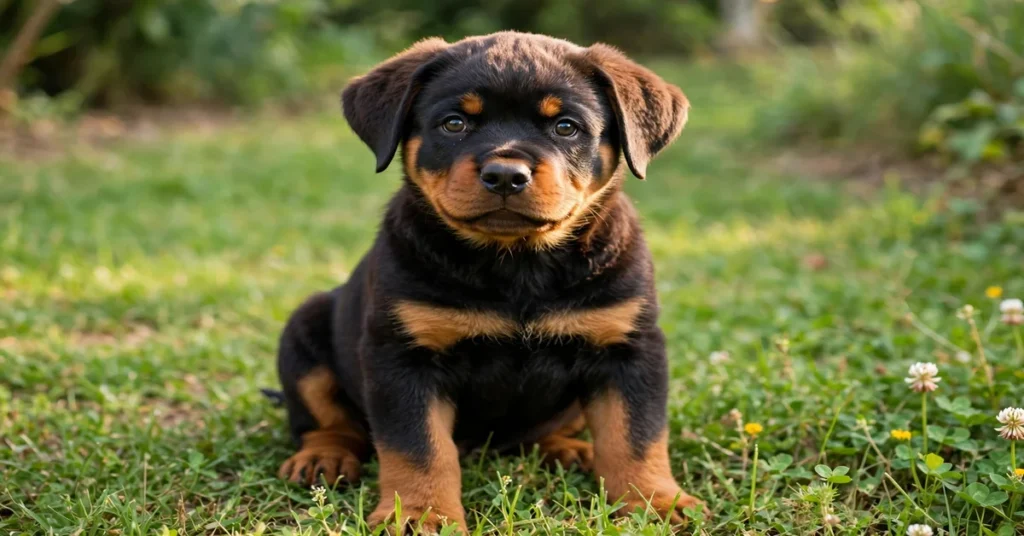
When I first meet a rottweiler puppy, I do not see a tough guard dog. I see a thoughtful, watchful little student who is asking me one big question: can I trust you to lead me?
I am Marcus Reed, a CPDT-KA certified trainer with 8 years and 300 plus dogs behind me. Rottweilers are smart, steady, and deeply loyal, but they are serious puppies who grow into 80 to 135 pound adults. What you do in the first year shapes everything.
This guide covers temperament, training, socialization, exercise, health, feeding, grooming, cost, and the myths people love to repeat. By the end, you will know exactly whether this breed fits your life.
Quick Answer: What They Are Really Like
A rottweiler puppy is a large, confident, calm companion in the making. These puppies bond deeply with their families and learn fast with positive training. They are not wild or mean by nature.
But they do need early training, heavy socialization, joint safe exercise, and a calm, confident owner. If you can give them structure and time, you get one of the most devoted dogs in the world.
📋 Contents (click to open)
- Quick Answer
- Breed Snapshot
- Temperament
- Early Training
- Socialization
- Exercise
- Health and Feeding
- Daily Life: Grooming, Cost, and Myths
- Breed Comparison
- Rottweiler Puppy Growth Chart: Weight by Age
- Teething: The 3 to 6 Month Chewing Storm
- Health Clearances: The Paperwork to Ask Any Breeder For
- Conclusion
- FAQs
Breed Snapshot: Your Rottweiler Puppy at a Glance
Rottweilers descend from Roman mastiffs and were developed in Germany as cattle drovers and guardians. The AKC breed page describes them as gentle family playmates with a self assured aloofness toward the outside world.
Adult size: 22 to 27 inches tall, 80 to 135 pounds. Males run bigger than females.
Lifespan: 9 to 10 years with good care.
Coat: short, smooth black coat with rich tan markings.
Group: Working Group.
Best for: confident, experienced owners with time for training and a secure yard or large home.
Do not let the cute puppy rolls fool you. Plan for the adult from day one.
Temperament: Loyal, Confident, Calm but Powerful
A well raised Rottweiler is loyal, confident, and calm. They follow their people everywhere and want to be part of everything. With family they are playful, affectionate, and often goofy.
With strangers they are watchful and reserved. That is the breed doing its job: notice first, decide second. Your calm greeting tells your dog a guest is fine.
Power is the part new owners underestimate. An excited 90 pound dog who jumps can hurt someone by accident. A calm dog is a safe dog, and calmness is trained, not born.
Early Training: Your Rottweiler Puppy Needs Calm Leadership
Training starts the day you bring your pup home. At 8 to 10 weeks old, their brain is wide open. Every rule you set now becomes their normal for life.
Start with these five basics: name recognition, sit, down, recall, and a place cue like a mat or bed. Keep sessions to 5 minutes.
Use positive reinforcement only. Treats, praise, and play build a dog who loves to work with you. Harsh corrections create fear, and a fearful Rottweiler is a dangerous mix of power and worry.
Set clear boundaries early. No jumping, no mouthing, no pulling on the leash. Rottweilers test consistency, and mixed rules confuse them.
Enroll in a puppy class by 10 to 12 weeks, after the first round of shots. It teaches your puppy to listen around other dogs and people.
Socialization: Show Your Puppy the World
Socialization is your most important job in the first 4 months. Your rottweiler puppy watches how you react to strangers, and your calm example teaches them that new things are safe.
Introduce your puppy to 100 new experiences before 16 weeks: men with hats, kids on bikes, umbrellas, vet waiting rooms, traffic sounds, calm friendly dogs. Keep meetings short and happy, and treat for calm behavior.
One scary experience at the dog park can undo ten good ones. Choose calm, vaccinated adult dogs for playdates.
Do not wait for the full vaccine series. Carry your puppy or sit on a bench near a busy sidewalk. Vets agree the risk of missing socialization is bigger than the risk of careful outings.
Exercise: Structured Play for Growing Joints
Rottweiler puppies need daily exercise, but the type matters more than the amount. Their bones and joints are still growing, and hard pounding on pavement can cause lasting damage.
Follow the 5 minute rule: about 5 minutes of leashed walking per month of age, twice a day. Add free play on grass and short training games.
Great puppy activities include sniff walks, food puzzles, gentle tug, and swimming. These build muscle without hammering young joints.
Skip long runs and hard jumps until your vet says the growth plates are closed, usually around 18 months. Build slowly toward the adult need of 60 minutes a day.
A mentally tired puppy is even better than a physically tired one. Ten minutes of training games burns more energy than a long walk.
Health: What Every Rottweiler Puppy Owner Should Watch For
This breed carries some real health risks. Knowing them early helps you catch problems while they are still small. The PetMD breed guide names routine vet exams and weight control as the two biggest health tools.
Hip and elbow dysplasia are the most common issues, causing limping, pain, and later arthritis. Choose a breeder who screens parents with OFA or PennHIP scores.
Heart problems run in the breed, especially subaortic stenosis. A vet can hear a murmur with a stethoscope, so never skip puppy checkups.
Osteosarcoma, an aggressive bone cancer, appears more often in Rottweilers than in most breeds. Sudden lameness or leg swelling deserves a same week vet visit.
Bloat (GDV) is a life threatening emergency in deep chested breeds. Feed smaller meals, rest your dog for an hour after eating, and learn the warning signs: swollen belly and retching without vomiting.
Obesity makes every one of these problems worse. Keep your puppy lean. You should be able to feel the ribs with a light touch.
Feeding: Large Breed Puppy Food Done Right
Feed a large breed puppy formula approved by AAFCO. These foods control calcium and calories so your puppy grows at a steady, safe speed. Fast growth is a top trigger for joint problems.
Split food into 3 to 4 small meals a day. Measured portions beat free feeding. Adjust with your vet based on your puppy’s body condition.
Switch to adult food around 12 months. Ask your vet about joint support as your dog matures, and keep treats under 10 percent of daily calories.
Daily Life: Grooming, Cost, Myths, and Fit
Grooming Is the Easy Part
Rottweilers are one of the easiest big breeds to groom. A weekly brushing with a rubber curry or slicker keeps the short coat shiny and cuts down loose hair. They shed year round, so a good vacuum is part of the package.
Bathe only when dirty, trim nails every 2 to 3 weeks, and check floppy ears weekly. Start tooth brushing early so it becomes routine.
The Real Cost
A well bred Rottie from a health tested breeder usually costs 800 to 2,500 dollars. Add first year vet care at 500 to 1,000 dollars, food at 60 to 100 dollars a month, plus a crate, bed, and training classes.
Budget for the long term too. Pet insurance is smart for this breed given the health risks. Over a lifetime, expect 1,500 to 3,000 dollars a year for food, vet care, and supplies.
Myths vs Reality
Myth: Rottweilers are born aggressive. Reality: aggression is not a breed trait. It comes from poor breeding, no socialization, or harsh handling. A well raised Rottweiler is calm and stable.
Myth: they turn on their owners. Reality: this breed bonds fiercely with family. Incidents almost always trace back to fear, pain, or a puppy never taught bite control.
Myth: they are too dumb to train. Reality: they are one of the smartest working breeds. They just bore with dull repetition, so keep training fun and fair.
Is This Breed Right for You?
A Rottweiler fits you if you can say yes to all of these. I have time for daily training and socialization. I want a big, powerful dog and I am not afraid of one. I can afford large breed food, vet bills, and insurance. I have space and a secure fence or a plan for real daily exercise.
Skip this breed if you want a low effort dog or live somewhere with breed bans. Be honest here. The wrong match is unfair to both of you.
How Rottweilers Compare to Similar Breeds
Here is my trainer’s quick take on how they compare.
| Breed | Adult Size | Guard Instinct | Trainability | Energy Level |
|---|---|---|---|---|
| Rottweiler | 80 to 135 lbs | Very strong, calm watcher | High, learns fast but tests rules | Medium, needs 60 min daily |
| German Shepherd | 50 to 90 lbs | Very strong, more vocal | Very high, eager to please | High, needs 90 min plus mental work |
| Doberman | 60 to 100 lbs | Strong, velcro shadow dog | High, sensitive to tone | High, athletic and bouncy |
| Boxer | 50 to 80 lbs | Moderate, playful protector | Medium, distractible clown | Very high, stays puppy-like for years |
The Rottweiler is the calmest of the four. If you want power with an off switch, this is your breed.
Rottweiler Puppy Growth Chart: Weight by Age
Rottweiler puppies grow at a startling pace. A pup you can carry in one arm in October can outweigh a small adult by spring. This chart shows the typical ranges most healthy puppies follow.
| Age | Typical Weight | Owner Focus |
|---|---|---|
| 8 weeks | 13 to 25 lbs | Settling in, first vet visit |
| 3 months | 26 to 40 lbs | Socialization in full swing |
| 4 months | 39 to 55 lbs | Teething starts, food portions climb |
| 6 months | 55 to 77 lbs | Teenage testing begins |
| 9 months | 70 to 100 lbs | Near full height, still filling out |
| 12 months | 77 to 110 lbs | Looks grown, brain still catching up |
| Adult | 80 to 100 lbs (female), 95 to 135 lbs (male) | Fully mature at about 2 years |
Every puppy grows on its own curve, and males, females, and different bloodlines vary a lot. What matters is the trend: steady gain, ribs you can feel but not see, and a visible waist. Chasing the top of the range is a mistake. Extra weight on growing joints does real damage, so keep your puppy lean and let genetics pick the final size.
Teething: The 3 to 6 Month Chewing Storm
Somewhere around 3 months, your sweet puppy turns into a small land shark. That is teething. Baby teeth loosen, adult teeth push through, and your pup’s mouth hurts enough that chewing on everything becomes a full time job.
Expect to find tiny teeth on the floor, sore red gums, and a sudden obsession with chair legs and baseboards. It is normal, and it passes. By about 7 months, most Rottweilers have their full set of 42 adult teeth.
Help your puppy through it. Offer frozen wet washcloths, rubber chew toys, and puppy-safe teething rings, and rotate them so there is always something cold to gnaw. Keep shoes, cords, and kids’ toys picked up, because a teething Rottweiler cannot tell a toy from a table leg.
One thing to watch: if a baby tooth refuses to fall out while the adult tooth grows in beside it, mention it to your vet. Retained baby teeth can crowd the bite and are simple to fix early.
Health Clearances: The Paperwork to Ask Any Breeder For
Every breeder says their puppies are “vet checked.” That is a good start, but it is not the same as health screening. A vet check says a puppy looks healthy today. Clearances say the parents were tested for the problems this breed passes down.
Before you put down a deposit, ask to see results for both parents in four areas: hips, elbows, heart, and eyes. Hip and elbow scores protect the joints. A cardiac exam screens for the heart defect this breed is known for. An eye exam rules out inherited eye disease.
There is one more test that matters. JLPP, a nerve disease that can paralyze young Rottweilers, has a simple DNA test, and the American Rottweiler Club requires it for breeding dogs. A breeder who tests for JLPP is telling you they take this seriously.
Good breeders hand over copies without hesitation. If the paperwork is always “coming soon,” keep looking.
Conclusion
Raising a Rottie is one of the most rewarding projects in dog ownership. Give them calm leadership, early training, tons of socialization, and joint safe exercise, and you will earn a loyal partner for the next decade.
Skip the shortcuts and the myths. This breed does not need a tough owner. It needs a steady one. Be that person, and your Rottweiler will be the dog other owners admire at the park.
Related Guides
- German Shepherd Puppy: Complete First Year Guide (2026)
- Belgian Malinois Puppy: The Honest Guide Most Owners Read Too Late
- Doberman Puppy: Training, Care & Cost Guide (2026)
- Puppy Training: 7-Day Starter Plan That Works (2026)
- Best Puppy Food: 7 Smart Label Checks Before You Buy (2026)
- Puppy Vaccine Schedule: What Happens at Every Visit (2026)
- Border Collie Puppy: The Complete Genius Puppy Manual
- How Much to Feed a Puppy: Simple Chart by Age and Size
Frequently Asked Questions
Are rottweiler puppies good with kids?
Yes, with early training and socialization. Rottweilers are often gentle with children in their own family. Always supervise play and never leave a large puppy alone with a small child.
Are rottweiler puppies aggressive?
No. Aggression comes from poor breeding, no socialization, or harsh handling. A well bred, well socialized pup raised with positive training grows into a calm, stable dog.
How much exercise does a rottweiler puppy need each day?
Follow the 5 minute rule: 5 minutes of leashed walking per month of age, twice a day, plus play and training games. Avoid hard running until growth plates close around 18 months.
When do rottweiler puppies calm down?
Most settle between 18 months and 2 years as training pays off. Consistent daily training and mental exercise speed this up. An undertrained 2 year old still acts like a teenager.
How big will my Rottweiler get?
Adults stand 22 to 27 inches tall and weigh 80 to 135 pounds, males larger than females. Growth is fastest in the first 6 months, with full maturity around 2 years.
Are Rottweilers easy to train?
Yes. They learn fast because they are smart and eager to please. The challenge is consistency: keep sessions short, fun, and fair, and always reward good choices.