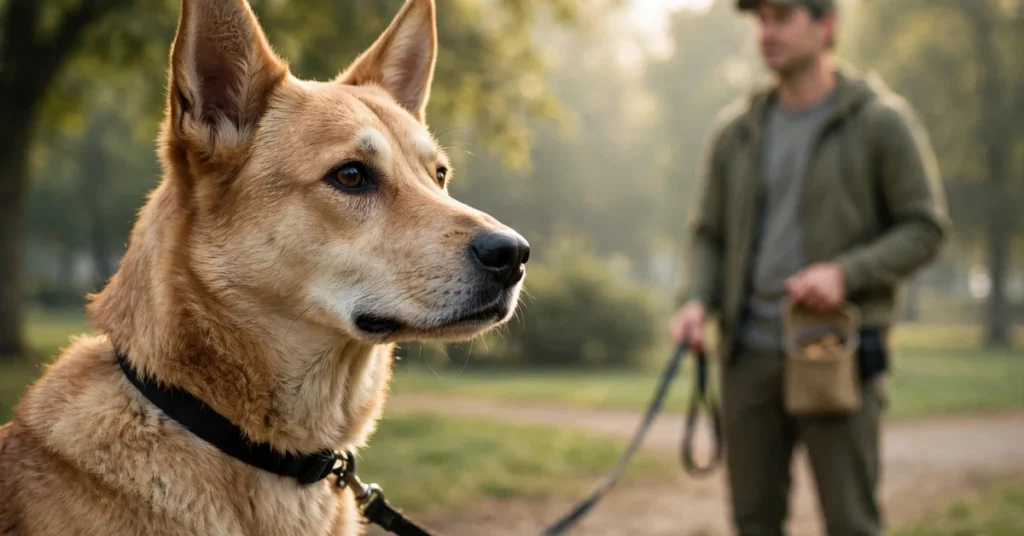
Your dog spots another dog across the street and explodes. Barking, lunging, twisting at the end of the leash. Heads turn, and you feel judged and helpless.
I have stood where you are standing more times than I can count. Hear this first: your dog is not bad, and you are not a failure. Reactive dog training is not about forcing obedience. It is about calming the fear underneath the noise.
I am Marcus Reed, a CPDT-KA certified trainer. My Labrador Cooper used to lose his mind at joggers. Here is the kind plan that fixed him.
Quick Answer
Reactivity is fear, not disobedience. Your dog barks and lunges because something scares or frustrates them.
Training changes the feeling. Stay far enough from triggers to keep your dog calm, then pair every calm sighting with high-value treats. Over weeks, triggers start to predict good things.
Manage first, never punish. Quiet walks and a front-clip harness beat corrections every time. Punishing fear only makes it worse.
📋 Contents (click to open)
- Quick Answer
- What Reactivity Really Is: Fear, Not Disobedience
- 3 Myths About Reactive Dog Training
- Management First: Distance Is Your Best Friend
- The Reactive Dog Training Protocol: 4 Steps
- The “Look at That” Game: Your Secret Weapon
- BAT Basics: Let Your Dog Choose Calm
- Reactive Dog Training Techniques Compared
- Safety Rules: What You Must Never Do
- When to Call a Professional
- Conclusion
- Related Guides
- Frequently Asked Questions
What Reactivity Really Is: Fear, Not Disobedience
A reactive dog overreacts to a trigger: usually other dogs, but also people, bikes, cars, or bins. The reaction looks dramatic: barking, lunging, growling.
Here is what most people miss. The reaction is not attitude. It is emotion. Barking and lunging mean “that is too much for me.”
You cannot drill fear away with obedience. Reactive dog training works on the feeling first. Change the feeling, and the barking fades.
Fear: “That might hurt me.” The dog wants distance. This is the most common driver I see.
Frustration: “I want to say hi and this leash will not let me.” Often mistaken for aggression.
3 Myths About Reactive Dog Training
Myth 1: “My dog is aggressive, not reactive”
An aggressive dog wants to cause harm. A reactive dog wants the scary thing to leave, or wants to reach the exciting thing. Most are reactive, not aggressive.
Myth 2: “More exposure will fix it”
Forcing a reactive dog into busy places to “get used to it” backfires. This is called flooding, and it deepens fear. Calm exposure at a safe distance is what works.
Myth 3: “My dog needs to be put in their place”
Dogs do not react from disrespect. They react because they are overwhelmed. Punishment just adds your scary consequences to the trigger.
Management First: Distance Is Your Best Friend
Before training starts, stop the rehearsals. Every explosion strengthens the habit. Arrange life so reactions rarely happen.
Distance is your best tool. Crossing the street is not giving up. It is giving your dog room to learn.
- Walk at quiet times. Early morning and late evening mean fewer triggers.
- Cross the street before your dog reacts. No shame in it.
- Use a front-clip harness and a fixed 6-foot leash. Skip retractable leashes.
- Let your dog sniff. Sniffing lowers stress fast.
- Protect rest. Tired dogs react more.
The Reactive Dog Training Protocol: 4 Steps
This is the heart of it: desensitization and counterconditioning, in plain English.
One sentence: Show the trigger at a distance your dog can handle, then make wonderful things happen every time it appears. Soon it predicts treats, not fear.
Step 1: Find the Threshold
How close can your dog get to a trigger and still take treats? That is your starting line. No treat-taking means you are too close.
Step 2: Pair the Trigger With Treats
The moment your dog notices the trigger, say “yes” and feed cheese or chicken bits, one after another. Trigger appears, treats flow. Trigger leaves, treats stop.
Step 3: Teach a Happy U-Turn
When you spot a trigger, say “this way,” turn, and reward your dog for following. Practice at home first.
Step 4: Shrink the Distance Slowly
Move closer only when your dog sees the trigger and looks at you, relaxed, expecting treats. If reactions return, you rushed it. The ASPCA’s leash-reactive dog guide walks through this exact exercise.
The “Look at That” Game: Your Secret Weapon
This game turns staring at triggers into a treat machine.
- Your dog glances at a trigger calmly. Say “yes” the instant they look.
- Reward, then let them glance back.
- Say “yes” and reward each calm look.
Your dog learns that noticing calmly pays better than reacting. Soon they glance, then whip their head back to you. That head whip is progress. End sessions while your dog is winning.
BAT Basics: Let Your Dog Choose Calm
BAT means Behavior Adjustment Training, and it suits fearful dogs well. Let your dog notice a trigger at a safe distance. When they look away, sniff, or turn, say “yes” and reward. Or let them move away, with space as the reward.
Distance is a reward. Dogs who learn that calm choices earn space start choosing calm. For the science, the AKC explains how desensitization and counterconditioning change emotions.
Reactive Dog Training Techniques Compared
Different tools for different dogs. Here is how the main methods compare.
| Technique | How It Works | Best For |
|---|---|---|
| Desensitization + Counterconditioning | Trigger appears at a safe distance while treats flow; distance shrinks over weeks | Almost every reactive dog |
| “Look at That” Game | Reward calm glances at the trigger; noticing pays | Dogs who fixate or stare first |
| BAT | Reward the dog’s own calm choices with space | Fearful dogs who freeze or flee |
| U-Turns and Pattern Games | Rehearsed escape routes near triggers | Real-life walks and surprises |
My take: I combine counterconditioning with the LAT game for most dogs, and add BAT for fearful ones. Cooper needed all three.
Safety Rules: What You Must Never Do
These safety rules are not optional.
Never punish reactivity. Yelling, leash pops, and prong or shock collars add fear to fear. Punishment can silence warning growls, making bites more likely.
Muzzle training is kind. A basket muzzle lets your dog pant, drink, and take treats. Condition it with treats at home first.
Control greetings. Do not let strangers or off-leash dogs rush your dog. “We are training, please give us space” works wonders.
Check health first. Pain worsens reactivity. Sudden reactivity deserves a vet visit.
When to Call a Professional
Call a certified trainer or veterinary behaviorist if your dog has bitten, reactivity keeps worsening, your dog cannot settle at home, or you feel scared of your own dog.
Look for CPDT-KA or IAABC credentials and force-free methods. Ask: “What happens when my dog gets it wrong?” If the answer involves pain or fear, walk away.
Conclusion
Your reactive dog is not giving you a hard time. They are having a hard time. That one shift changes everything.
Progress is not a straight line. A bad day means the distance was too short or the day too long. Adjust and try again tomorrow. Cooper once barked himself hoarse at every jogger. Now he checks in for his treat. Your dog can get there too.
Can a reactive dog be trained?
Yes. Most improve a lot. Training changes the fear underneath the barking, using distance, treats, and calm practice over weeks to months.
How long does reactive dog training take?
Mild cases often improve in 4 to 8 weeks of steady work. Deeper fear-based reactivity can take 3 to 6 months or longer.
What is the best way to train a reactive dog?
Desensitization plus counterconditioning: stay where your dog stays calm, and pair every trigger sighting with treats. Add the LAT game and U-turns. Never punish.
Should you punish a reactive dog?
No. Punishment adds fear to fear and can silence warning growls, making bites more likely. The AKC and ASPCA back force-free methods.
Can a reactive dog ever be fully cured?
Some mildly reactive dogs stop noticing old triggers. Dogs with deeper fear improve hugely but do best with lifelong management, like quieter routes.
What triggers reactive behavior in dogs?
Other dogs, strangers, bikes, cars, and some sounds. Most reactivity comes from fear or frustration on leash.
Related Guides
- Service Dog Training: Honest Guide to Costs and Rules (2026)
- Puppy Training: 7-Day Starter Plan That Works (2026)
- Dog Obedience Training: 5 Commands Every Dog Should Know
- Dog Skin Allergies: Signs, Causes and 9 Relief Tips (2026)
- Best Dog Breeds for Families: 12 Kid-Friendly Picks for Every Home (2026)
- German Shepherd Puppy: Complete First Year Guide (2026)
- Dog Treats: 9 Healthy Picks Every Dog Owner Must Try (2026)
- Dog Names: 150+ Best Picks for 2026 (Male, Female & Unique)
Frequently Asked Questions
Can a reactive dog be trained?
Yes. Most reactive dogs improve a lot. Reactive dog training changes the fear underneath the barking, using safe distance, high-value treats, and calm practice over weeks to months.
How long does reactive dog training take?
Mild cases often improve in 4 to 8 weeks of steady work. Deeper fear-based reactivity can take 3 to 6 months or longer. The longer a dog has practiced reacting, the longer new habits take to build.
What is the best way to train a reactive dog?
The best method is desensitization plus counterconditioning: stay at a distance where your dog stays calm and pair every trigger sighting with high-value treats. Add the LAT game and happy U-turns, and never punish.
Should you punish a reactive dog for barking and lunging?
No. Punishment adds fear to fear and can silence warning growls, which makes a bite more likely. The AKC and ASPCA back force-free methods for reactivity.
Can a reactive dog ever be fully cured?
Some mildly reactive dogs stop noticing old triggers. Dogs with deeper fear often improve hugely but do best with lifelong management, like quieter routes.
What triggers reactive behavior in dogs?
Other dogs, strangers, bikes, cars, and some sounds. Most reactivity comes from fear or frustration on leash.