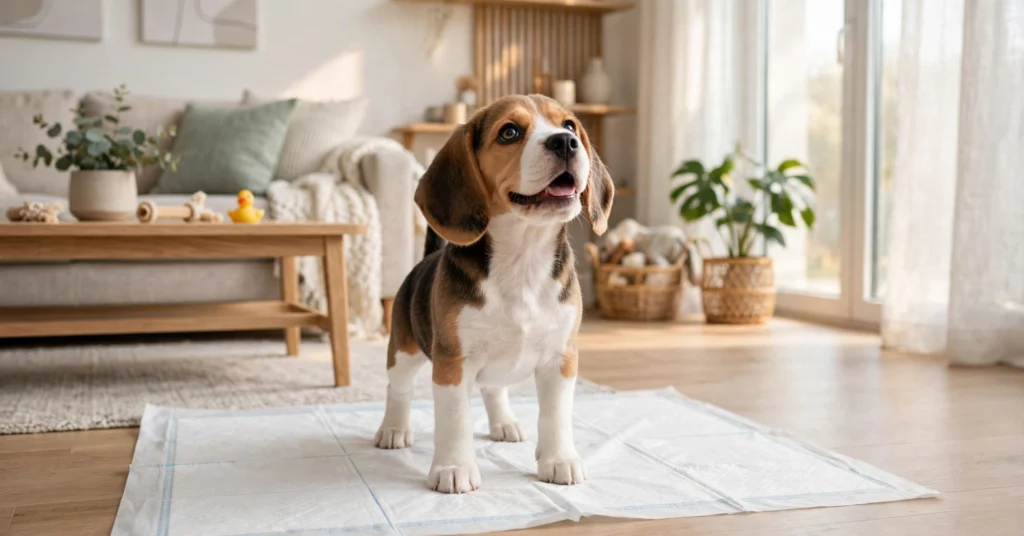
Those first weeks with a puppy are wonderful and exhausting. The chewing, the 3 AM wake-ups, and yes, the puddles. Puppy pads promise to make the mess manageable, and they can, if you use them right.
But here is what most pad packages will not tell you. Pads can also slow down house training if you use them wrong. I have seen puppies learn pads in days and then take months to learn that outside is the real bathroom.
I am Marcus Reed, a CPDT-KA certified trainer with 8 years of hands-on experience. This guide will show you when puppy pads help, how to train with them step by step, and how to transition outside without confusing your pup.
Quick Answer
Short on time? Here is the core of it.
When pads help: Apartments, long workdays, tiny breeds, bad weather, and very young puppies who cannot hold it.
The right setup: One pad in one consistent spot, away from food and bed. Reward every success on the pad like it is the best thing your puppy has ever done.
The big warning: Pads teach “inside is okay.” The AKC notes that pads can slow the transition to outdoor elimination, so plan the move outside from day one.
📋 Contents (click to open)
- Quick Answer
- What Puppy Pads Are (and Are Not)
- 4 Types of Puppy Pads Compared
- When Puppy Pads Help (and When to Skip Them)
- Setting Up: Location Matters Most
- How to Train Your Puppy on Pads: 6 Steps
- Transitioning From Pads to Outside
- 5 Puppy Pad Mistakes That Backfire
- Conclusion
- Related Guides
- Frequently Asked Questions
What Puppy Pads Are (and Are Not)
Puppy pads are absorbent rectangles with a waterproof backing. Most have a scent attractant that encourages puppies to eliminate on them. They protect your floors while your puppy learns.
What they are not: a permanent bathroom. Pads are training wheels, not the bicycle. The goal is always reliable outdoor elimination eventually, unless your living situation truly requires an indoor option.
4 Types of Puppy Pads Compared
| Type | Pros | Cons | Best For |
|---|---|---|---|
| Disposable pads | Convenient, scented, no laundry | Ongoing cost, landfill waste | Most beginners |
| Washable pads | Reusable, economical long-term | Laundry, higher upfront cost | Eco-conscious owners |
| Grass pads | Real grass feel, easier outdoor transition | Needs replacing, can smell | Apartment dwellers |
| Litter box style | Contained, good for tiny breeds | Some puppies chew the litter | Toy breeds, high-rises |
Marcus tip: Start with disposable scented pads. They are the easiest for puppies to understand. You can switch to washable or grass later once the habit is built.
When Puppy Pads Help (and When to Skip Them)
Pads help when: you work long hours and cannot get home, you live in a high-rise, your puppy is under 12 weeks and cannot hold it, winter weather is brutal, or you have a tiny breed with a tiny bladder.
Skip pads when: someone is home most of the day, you have easy yard access, or your puppy is already reliably going outside. If outdoor training is working, do not add pads. You would be teaching two bathrooms instead of one.
Setting Up: Location Matters Most
Pad training fails most often because of bad placement, not bad puppies.
- One spot, always. Pick a single location and never move it during training. Consistency builds the habit.
- Away from bed and food. Dogs avoid soiling where they sleep and eat. Put the pad in a separate area.
- Easy to reach. Your puppy must get there fast. A pad three rooms away might as well not exist.
- Hard floors underneath. Accidents happen. Tile or laminate cleans up; carpet remembers.
- Confine the space. Use a playpen or baby gates at first. A small area with the pad in it makes success likely.
How to Train Your Puppy on Pads: 6 Steps
Step 1: Introduce the pad
Let your puppy sniff and walk on the pad. Treat for any interest. Make the pad a good place before it is a bathroom.
Step 2: Watch for the signs
Sniffing in circles, squatting, sudden restlessness. These mean “I need to go.” Common times: after waking, after eating, after playing, after drinking.
Step 3: Place and cue
Calmly place your puppy on the pad and say your cue, like “go potty.” Use the same words every time.
Step 4: Reward like crazy
The instant your puppy finishes on the pad, celebrate. Happy voice, a treat, a little party. Your reaction teaches faster than any pad scent ever will.
Step 5: Clean misses calmly
Accidents will happen. Clean with an enzymatic cleaner, no scolding. PetMD’s vets remind us to never punish housetraining mistakes, just manage better next time.
Step 6: Expand freedom slowly
After two accident-free weeks, give your puppy a little more space. If accidents return, shrink the area again. Rushing freedom is the number one cause of setbacks.
Transitioning From Pads to Outside
This is where most owners get stuck. Here is the method that works.
- Move the pad toward the door. A few feet every few days. Your puppy follows the pad’s location.
- Then move it just outside the door. Same pad, new location. Reward outdoor use hugely.
- Shrink the pad. Fold it smaller over a week until it is gone.
- Keep the schedule. Take your puppy out at the same times the pad was being used. Routine carries the habit.
Expect a wobble. Most puppies have a few accidents during transition. That is normal learning, not failure. Stay consistent for two weeks and the new habit locks in.
5 Puppy Pad Mistakes That Backfire
1. Pads everywhere. Pads in every room teach your puppy that the whole house is a bathroom. One pad, one spot.
2. Punishing accidents. Scolding teaches your puppy to hide to pee, not to hold it. Clean calmly and manage better.
3. No transition plan. Using pads “for now” with no plan to move outside creates a permanent indoor habit.
4. Too much freedom too fast. A puppy earning house freedom in weeks is a fantasy. Months of supervision is the reality.
5. Dirty pads. Most puppies refuse a soiled pad. Change it after every use or two, or your puppy will pick the rug instead.
Conclusion
Puppy pads are a tool, and like any tool, they work when you use them with a plan. Set up one consistent spot, reward every success, and start the outdoor transition early.
Remember what the pads are for: buying you time while your puppy’s bladder catches up with their brain. Most puppies get there. Yours will too.
Be patient, stay consistent, and celebrate the wins. One day you will realize the pads have been gone for weeks and you did not even notice.
Related Guides
- Puppy Training: 7-Day Starter Plan That Works (2026)
- Best Puppy Food: 7 Smart Label Checks Before You Buy (2026)
- Puppy Food: What Every New Owner Must Know Before Buying
- How Much to Feed a Puppy: Simple Chart by Age and Size
- Puppy Vaccine Schedule: What Happens at Every Visit (2026)
- Beagle Puppy Training & Care: Raise a Happy Scent Hound
- German Shepherd Puppy: Complete First Year Guide (2026)
- Dog Obedience Training: 5 Commands Every Dog Should Know
Frequently Asked Questions
Are puppy pads a good idea?
They are useful for apartments, long workdays, tiny breeds, and very young puppies. But they can slow the transition to outdoor elimination, so always have a plan to move outside.
How long should I use puppy pads?
Most puppies can start transitioning outside between 4 and 6 months, as bladder control improves. Start moving the pad toward the door once your puppy uses it reliably.
Do puppy pads confuse puppies?
They can, if used without a plan. One pad in one consistent spot, plus a clear transition to outside, prevents most confusion. Pads everywhere teach that everywhere is fine.
How do I stop my puppy from chewing the pad?
Provide plenty of chew toys, supervise pad time, and consider a pad holder that keeps edges tucked. Boredom drives most pad chewing, so more play and training helps.
Can I use puppy pads and outdoor training together?
Yes, with a clear system: pads for when you cannot get home, outside whenever you can. Keep the pad in one spot and reward outdoor elimination even more enthusiastically.
What is better: disposable or washable puppy pads?
Disposable pads are easier for beginners thanks to scent attractants and no laundry. Washable pads save money long-term and reduce waste. Both work; pick what fits your life.