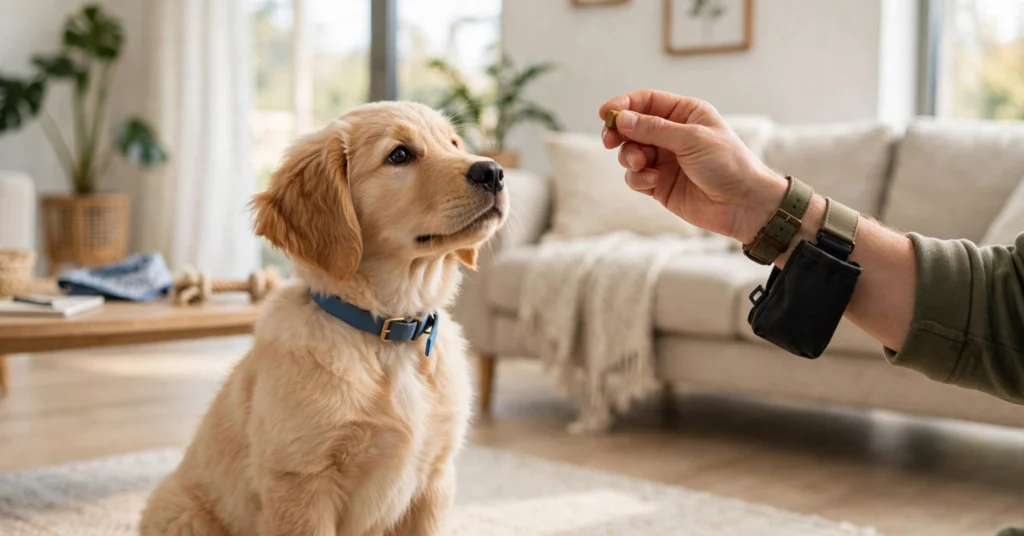
Your new puppy just peed on the rug. Again. And now they are chewing your favorite shoe.
Take a breath. Puppy training feels hard because nobody tells you where to start. Most guides throw 50 commands at you at once. That is not how real training works.
I have trained over 300 dogs in 8 years as a certified trainer. Here is the truth: your puppy only needs five skills in the first month. This guide gives you a simple 7-day starter plan, the exact first commands to teach, and the mistakes that slow everyone down.
Let us build a calm, happy puppy. One small win at a time.
Quick Answer: Puppy Training Basics
Short on time? Here is what matters most.
Start day one. Puppies as young as 8 weeks can learn. Keep sessions to 5 minutes, 2 to 3 times a day.
Teach these first: name recognition, sit, come, potty routine, and crate comfort.
Use rewards, not punishment. Treats, praise, and play build faster learning than scolding ever will.
Want the full day-by-day plan? Keep reading.
📋 Contents (click to open)
- Quick Answer: Puppy Training Basics
- Your First 7 Days: The Starter Plan
- The 5 First Commands to Teach
- Puppy Training Commands: Quick Reference
- The Potty Training Plan
- Crate Training Without the Crying
- Training and Socialization: The Other Half
- 5 Puppy Training Mistakes to Avoid
- Conclusion
- Related Guides
- Frequently Asked Questions
Your First 7 Days: The Starter Plan
Forget the 6-month master plan. Your only job this week is to build routine and trust. Here is exactly what to do each day.
Day 1 to 2: Settle In
Let your puppy explore one room. Show them the water bowl, the bed, and the potty spot. Say their name cheerfully and reward them with a treat every time they look at you. That is it. No commands yet.
Day 3 to 4: Start the Routine
Feed at the same times each day. Take them to the potty spot after every meal, nap, and play session. Begin 3-minute name and sit sessions. End every session with play.
Day 5 to 7: Add the Basics
Introduce “come” in a hallway. Start crate games (toss treats inside, let them walk in freely). Practice gentle handling: touch paws, ears, and belly, then reward. This makes future vet visits easy.
Trainer tip: Ditch the food bowl this week. Feed half of each meal by hand as training rewards. Your puppy learns that good things come from listening to you.
The 5 First Commands to Teach
You do not need 20 commands. These five cover 90 percent of daily life with a puppy.
1. Name Recognition
Say the name once in a happy voice. When your puppy looks at you, say “yes” and give a treat. Repeat 10 times. Never use the name for scolding.
2. Sit
Hold a treat just above the nose, then move it slowly back over the head. The bottom drops naturally. Say “sit” as it happens, then reward. Most puppies learn this in one day.
3. Come
Start 6 feet away in a hallway. Crouch down, open your arms, and say “come” in an excited voice. Reward big when they run to you. Never chase a puppy that runs away. Make coming to you the best game ever.
4. Down
From a sit, lure the treat down between the front paws and slightly forward. Say “down” as the elbows touch the floor. Reward and release with “okay.”
5. Leave It
Hold a treat in a closed fist. When your puppy sniffs and backs off, say “yes” and reward from your other hand. This one command can save your puppy from eating something dangerous.
The the AKC puppy training guide breaks these skills down by age, which helps you know what to expect at 8 weeks versus 6 months.
Puppy Training Commands: Quick Reference
| Command | How to Teach It | Use It When |
|---|---|---|
| Name | Say once, reward the look | Getting attention anywhere |
| Sit | Lure treat over the head | Greetings, before meals, at doors |
| Come | Crouch, open arms, excited voice | Recall in safe spaces |
| Down | Lure from sit toward the floor | Settling, vet visits, photos |
| Leave it | Closed fist, reward the back-off | Dropped food, street trash, danger |
The Potty Training Plan
Potty training is where most owners lose patience. Here is the simple system that works.
The golden rule: Take your puppy out after every meal, every nap, every play session, and every hour in between. A 2-month-old puppy can hold it for about 2 hours at most.
The Routine
- Same spot every time. The smell tells them what to do.
- Same phrase. Say “go potty” as they start. They will learn the words.
- Reward immediately. Treat and praise within 3 seconds of finishing. Not when you get back inside.
- Supervise indoors. If you cannot watch them, use the crate or a playpen. Freedom is earned.
When Accidents Happen
They will. Never punish. Just clean with an enzyme cleaner and move on. Punishment teaches puppies to hide it from you, not to hold it.
Crate Training Without the Crying
A crate is not a cage. It is your puppy’s bedroom. Done right, most puppies love theirs.
- Make it cozy. Soft blanket, a safe chew toy, and a worn t-shirt that smells like you.
- Feed meals inside. Good things happen in the crate.
- Start with seconds, not hours. Toss a treat in, let them walk in, let them walk out. Build up slowly.
- Never use it as punishment. The crate must always feel safe.
Do not leave a young puppy crated all day. At 8 weeks, 2 hours is the max. At 12 weeks, about 3 to 4 hours. Longer than that is unfair and slows potty training.
Training and Socialization: The Other Half
Training commands is only half the job. The other half is socialization: teaching your puppy the world is safe.
Between 3 and 14 weeks, puppies are in a golden learning window. What they meet now shapes how they feel about it for life.
Safe Socialization Ideas
- Invite calm, vaccinated adult dogs to your home.
- Let your puppy watch the world from your arms or a blanket in a park.
- Introduce umbrellas, vacuums, doorbells, and hats. Pair each with treats.
- Handle paws, ears, and mouth daily so grooming and vet visits stay easy.
The ADAPTIL puppy training guide explains why the 3 to 16 week socialization window matters so much, with tips from a clinical animal behaviorist.
Quality beats quantity. One calm, positive meeting with a friendly dog teaches more than ten scary ones. If your puppy looks worried, increase distance and try again later.
5 Puppy Training Mistakes to Avoid
1. Training too long. After 5 minutes, a young puppy stops learning and starts getting silly. Short sessions win.
2. Repeating the command. Saying “sit, sit, SIT!” teaches your puppy to ignore the first two. Say it once, then help them succeed.
3. Only training indoors. Dogs do not generalize well. Practice in the yard, on walks, and at a friend’s house too.
4. Punishing accidents or mistakes. Fear slows learning. If your puppy messes up, ask what you can change in your setup.
5. Skipping the boring stuff. Everyone wants tricks. But a puppy that settles calmly and walks nicely is worth ten that can shake hands.
Conclusion
Puppy training is not about perfection. It is about showing up for 5 minutes a day and celebrating small wins.
Your puppy will have bad days. You will too. That is normal. Stay patient, keep it fun, and remember: the dog you are building today is the companion you will love for the next 12 to 15 years.
Start today. Keep it short. Reward the good stuff. You have got this.
Related Guides
- Dog Obedience Training: 5 Commands Every Dog Should Know
- Service Dog Training: Honest Guide to Costs and Rules (2026)
- Puppy Vaccine Schedule: What Happens at Every Visit (2026)
- How Much to Feed a Puppy: Simple Chart by Age and Size
- German Shepherd Puppy: Complete First Year Guide (2026)
- Best Puppy Food: 7 Smart Label Checks Before You Buy (2026)
- Dog Treats: 9 Healthy Picks Every Dog Owner Must Try (2026)
- Dog Names: 150+ Best Picks for 2026 (Male, Female & Unique)
Frequently Asked Questions
When should I start puppy training?
Start the day your puppy comes home, usually at 8 weeks old. Begin with name recognition, a potty routine, and gentle handling. Keep sessions to 3 to 5 minutes. Formal obedience can wait, but good habits start on day one.
How long should puppy training sessions be?
Keep sessions to 5 minutes for puppies under 12 weeks, and up to 10 minutes for older puppies. Do 2 to 3 short sessions per day. End on a success, even if that means asking for something easy your puppy already knows.
What is the first thing to teach a puppy?
Teach name recognition first, then a potty routine. After that, the most useful commands are sit, come, down, and leave it. These five skills cover almost everything a young puppy needs in daily life.
How do I stop my puppy from biting?
Puppy biting is normal. Redirect to a chew toy every time teeth touch skin. If they keep biting, calmly stand up and pause play for 20 seconds. Never hit or hold the muzzle shut. Most puppies outgrow hard biting by 6 months with consistent redirection.
Is it better to train a puppy yourself or hire a trainer?
Do both if you can. Daily short sessions at home build the bond and the habits. A good puppy class adds socialization and expert feedback. Avoid any trainer who uses shock collars, alpha rolls, or punishment based methods.
How long does it take to fully train a puppy?
Basic manners take 4 to 6 months of consistent work. But real reliability, especially around distractions, takes until 1 to 2 years old. Training never truly ends. Think of it as an ongoing conversation, not a course with a graduation date.