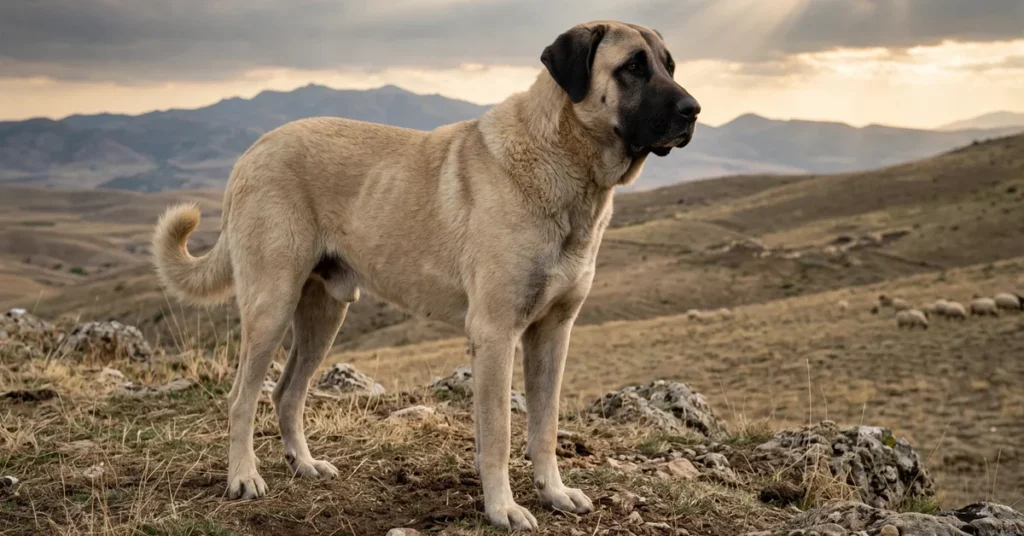
Picture this: a 140-pound tan giant standing calmly between a flock of sheep and a wolf, refusing to move an inch. That is the Kangal dog, Turkey’s legendary livestock guardian and one of the most powerful breeds on the planet. And yes, those bite force rumors you have heard are real.
I am Marcus Reed, a CPDT-KA certified dog trainer with 8 years of experience and more than 300 family dogs trained. Guardian breeds have been my specialty for most of my career, and the Kangal is the one breed that makes even experienced owners stop and think. Here is my honest, trainer-level breakdown.
This is not a dog for everyone, and I will not pretend otherwise. But for the right owner, with the right setup, a Kangal is something truly special. Let me walk you through both sides so you can decide with your eyes wide open.
Quick Answer: A Giant Guardian for the Right Home
The Kangal dog is a massive Turkish livestock guardian bred to face wolves and protect flocks on its own. Best for: experienced owners with large, securely fenced property who want a serious protector. Not for: apartments, first-time dog owners, or anyone who wants an easygoing family pet. They are calm and loyal at home, deeply suspicious of strangers, and they think for themselves. If you cannot commit to serious training and management, admire this breed from a distance.
📋 Contents (click to open)
- Quick Answer: A Giant Guardian for the Right Home
- From the Anatolian Plateau: The Kangal’s Turkish Roots
- Bred to Fight Wolves: The Guardian Instinct
- The 743 PSI Question: Bite Force Explained
- Gentle With Family, Suspicious of Strangers
- Training a 140-Pound Independent Thinker
- Health, Lifespan, and the Real Cost
- Conclusion
- Related Guides
- Frequently Asked Questions
From the Anatolian Plateau: The Kangal’s Turkish Roots
The Kangal dog was developed over centuries on the high Anatolian plateau in central Turkey. The breed takes its name from the Kangal district of Sivas Province, where shepherds needed a dog that could live outdoors year round and guard sheep and goats from wolves, bears, and jackals. This was not a pet project. It was survival.
In Turkey, the Kangal is a national treasure. The dogs are celebrated at festivals, appear on postage stamps, and are considered a cultural icon. As the AKC’s Anatolian Shepherd profile explains, these close cousins of the Kangal guarded livestock both near villages and on the high summer pastures, displaying remarkable consistency in appearance and temperament across the region.
Here is something most people miss: for centuries, Kangals worked alone or in pairs, making life or death decisions without a human standing nearby. That history shaped everything about them. The independence, the wariness of strangers, the calm confidence under pressure. It is all in the DNA, and no amount of modern pet life erases it.
Bred to Fight Wolves: The Guardian Instinct
Most guard dog breeds bark and threaten. The Kangal works differently. Its first instinct is to place itself between the threat and its charges, then assess. It prefers to intimidate predators away with sheer presence, but if a wolf calls the bluff, the Kangal will engage physically. This is a dog that was expected to win fights against apex predators and live to tell the tale.
How Kangals guard differently from other breeds
Protection breeds like German Shepherds were bred to take orders from a handler. Kangals were bred to think. A shepherd might be miles away, so the dog had to decide on its own when a situation was dangerous and how far to go. That is why owners describe them as calm, watchful, and almost eerily patient. They do not waste energy on false alarms. When a Kangal reacts, it means business.
What this instinct looks like in your home
Here is the honest part. That guardian brain does not switch off because the dog now lives in a suburb. A Kangal will patrol your property line, bark at unfamiliar vehicles, and position itself where it can see the front door. Without early socialization and strong boundaries, this instinct can turn into territorial aggression. I have seen sweet Kangal puppies grow into dogs their owners were afraid to walk. The instinct is the breed’s gift and its biggest management challenge.
The 743 PSI Question: Bite Force Explained
You have probably seen the number: 743 PSI. That figure makes the Kangal dog the most cited answer to the question of which breed bites hardest. For comparison, a German Shepherd is usually estimated around 238 PSI and a human bites at roughly 162 PSI. But let me give you the trainer’s honest context.
What 743 PSI really means
The 743 PSI number comes from limited, widely shared testing, not from a large scientific study. It is the best-known estimate we have, and even if the true number is somewhat lower, the point stands: a Kangal can generate an extraordinary bite. This is a dog built to crush through the thick hide and bone of a wolf. Respect that power. It is exactly why this breed demands an owner who takes management seriously.
A powerful bite, but a calm owner of that power
Here is the surprising truth: Kangals do not bite often. Their whole working style is built around deterrence first. A well raised Kangal would much rather stare down a threat than fight it. Bite incidents almost always trace back to the same causes I see in my training practice: poor socialization, no boundaries, an owner who confused size with control, or a dog put in a situation it should never have been in. The power is real. The temperament to use it wisely is also real, if you raise them right.
Gentle With Family, Suspicious of Strangers
Ask Kangal owners about life inside the house and you hear the same word over and over: gentle. Once a Kangal dog bonds with its family, it becomes a calm, affectionate, almost couch-like presence. They are famously good with children they know, often positioning themselves near the kids like a furry security detail. Many owners say their Kangal is the most loving dog they have ever had.
But walk a stranger through the front door and you meet a different animal. Kangals are deeply, instinctively suspicious of unfamiliar people and dogs. This is not shyness and it is not meanness. It is the guardian brain doing its job. Guests need proper introductions, and even then, many Kangals simply tolerate visitors rather than welcoming them.
So here is the question I always ask families: how often do strangers come to your home? Kids’ friends, delivery drivers, repair workers, neighbors dropping by? If your house is a social hub, a Kangal will be stressed and you will be stressed. This breed thrives in a calm, predictable household with a clear routine. Match the dog to your lifestyle, not to a fantasy.
Training a 140-Pound Independent Thinker
Training a Kangal dog is not like training a Lab. Labs want to please you. Kangals want to understand why. Remember, this breed was designed to make decisions without human guidance, so “because I said so” is not a compelling argument to them. That does not mean they cannot be trained. It means you have to earn their respect through calm, consistent leadership.
Start early, and I mean early. Socialization between 8 and 16 weeks is critical: different people, calm dogs, new environments, normal household sounds. Obedience work should be positive, firm, and boring in its consistency. Harsh corrections will backfire badly with this breed. A Kangal that decides you are a threat to be wary of is a serious problem. I always tell clients: train the puppy in front of you, not the giant it will become, because that giant arrives fast.
Exercise needs: more than you think, less than you fear
Kangals are not hyper dogs, but they are big, athletic working dogs that need a job. Expect at least an hour of purposeful activity daily: long walks, free running in a secure area, and mental work like scent games or structured training. A bored Kangal is a destructive Kangal, and a 140-pound bored dog can redesign your fence in an afternoon. Apartment life is simply not fair to this breed. They need space, and that space needs a tall, strong fence.
Health, Lifespan, and the Real Cost
Kangals are generally hardy dogs, shaped by centuries of natural selection in a harsh climate. Their lifespan is typically 12 to 15 years, which is impressive for a giant breed. The most common health concerns are the ones that follow large size: hip and elbow dysplasia, bloat (gastric torsion), and entropion, an eyelid condition seen in the breed. Choose a breeder who health tests, especially hips and elbows. It matters enormously at this size.
Now let us talk money, because giant dogs come with giant bills. A Kangal puppy from a reputable breeder typically costs $1,800 to $3,000 in the United States, sometimes more for proven working lines. Annual costs run high: a large breed eats a lot (budget $80 to $120 per month for quality food), vet bills scale with weight, and everything from crates to medications costs more. Pet insurance is worth serious consideration. If you are comparing breeds, PetMD’s Great Pyrenees guide is a useful starting point for understanding how guardian breeds differ in care needs.
| Breed | Weight | Bite Force (PSI) | Temperament | Training Need | Best For |
|---|---|---|---|---|---|
| Kangal | 90-145 lbs | ~743 | Calm, loyal, highly territorial | High, needs expert handling | Experienced owners with land |
| Anatolian Shepherd | 80-150 lbs | ~500-600 | Independent, reserved, watchful | High, similar guardian style | Farm owners wanting a guardian |
| Great Pyrenees | 85-120 lbs | ~500 | Gentle, patient, nocturnal barker | Moderate, stubborn streak | Families with space, first guardian |
| Caucasian Shepherd | 100-170 lbs | ~550-700 | Fearless, intensely protective | Very high, expert only | Serious protection, not casual pets |
| Tibetan Mastiff | 70-150 lbs | ~550 | Aloof, dignified, independent | High, needs confident owner | Owners wanting a majestic guardian |
| Akbash | 75-140 lbs | ~500 | Calm, intelligent, less aggressive | Moderate to high | Livestock owners, calmer guardian |
Conclusion
The Kangal dog is one of the most impressive animals you will ever meet: powerful, intelligent, loyal to its core, and shaped by a thousand years of honest work. It is also one of the most demanding. This breed needs space, structure, early socialization, and an owner who understands what a true guardian dog is.
If you have large property, guardian breed experience, and a calm household, a Kangal can be an extraordinary partner. If you are unsure about any of those things, start with a more forgiving breed and admire the Kangal from afar. Choosing the right dog is the kindest thing you can do for both of you.
Related Guides
- Livestock Guardian Dog Breeds: 10 Best Farm Protectors
- Large Dog Breeds: 15 Best Big Dogs for Families (2026)
- Police Dog Breeds: 10 Elite K9 Breeds and Their Roles
- Guard Dog Breeds: 10 Best Protectors for Families (2026)
- German Shepherd Puppy: Complete First Year Guide (2026)
- Most Aggressive Dog Breeds: 12 Ranked (Truth May Shock You)
- Smartest Dog Breeds: 15 Genius Pups Ranked (2026)
- Newfoundland Dog: Complete Guide
Frequently Asked Questions
Are Kangals good family dogs?
Kangals can be wonderful with their own family, including children they know. They are calm, gentle, and protective at home. However, they are deeply suspicious of strangers and need a calm, predictable household. They are not the right fit for very social homes with constant visitors.
How strong is a Kangal bite force?
The Kangal is widely cited at around 743 PSI, which is often listed as the strongest bite force of any dog breed. For comparison, a German Shepherd is estimated at about 238 PSI. The 743 figure comes from limited testing, but there is no doubt the Kangal has an exceptionally powerful bite.
Are Kangals aggressive?
Kangals are not randomly aggressive, but they are strongly territorial and wary of strangers. A well socialized Kangal is calm and controlled, preferring to intimidate rather than fight. Problems usually come from poor socialization, no training, or owners who cannot manage a giant guardian breed.
How big do Kangals get?
Male Kangals typically stand 29 to 33 inches tall and weigh 110 to 145 pounds. Females are slightly smaller at 27 to 31 inches and 90 to 130 pounds. They are slightly longer than they are tall, with a large head, black mask, and curled tail.
Are Kangals easy to train?
No, Kangals are not easy to train. They are independent thinkers bred to make decisions without human guidance. They need an experienced, consistent owner who uses calm, firm, positive methods. Early socialization between 8 and 16 weeks is absolutely critical.
How much does a Kangal puppy cost?
A Kangal puppy from a reputable breeder usually costs between $1,800 and $3,000 in the United States. Proven working lines can cost more. Remember that ongoing costs are high too, since giant breeds eat more and vet bills scale with size.