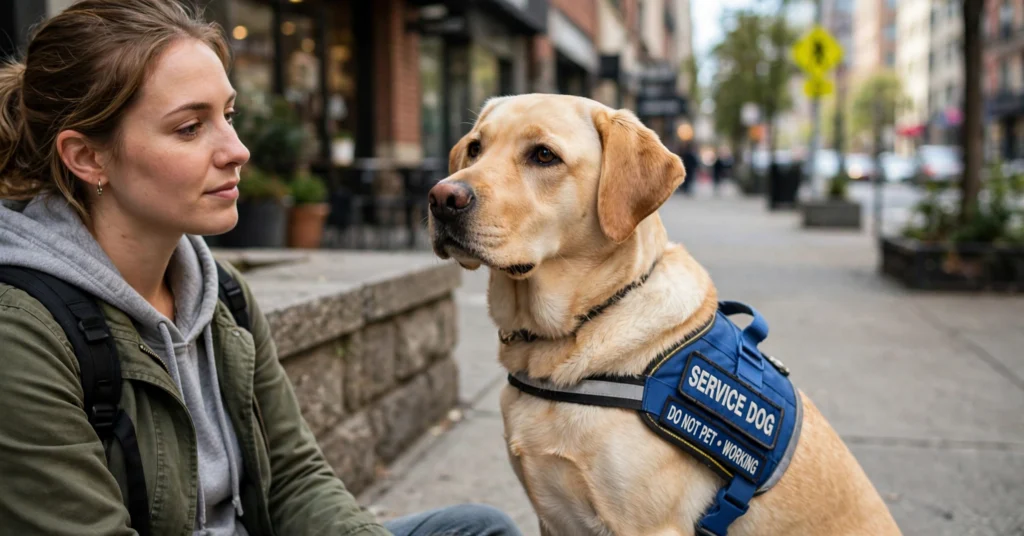
Someone online will sell you a “service dog certificate” for $79. Here is what they will not tell you: it means nothing under the law.
Service dog training is one of the most misunderstood topics in the dog world. Fake registries, scam vests, and bad advice are everywhere. I have spent 8 years training dogs, and I will give you the honest version: what the law actually says, what training really takes, and how to avoid getting scammed.
Whether you need a service dog yourself or you are just curious, this guide lays out the real roadmap.
Quick Answer: Service Dog Training
Short on time? Here are the facts.
No certification is required by law. The ADA does not require any certificate, vest, or registration for a service dog in the US.
Training takes 18 to 24 months. Industry standard is at least 120 hours of training, with 30 hours in public settings.
Professional training costs $15,000 to $40,000. Owner-training is legal but demands 1 to 2 hours of daily work.
Want the full honest breakdown? Keep reading.
📋 Contents (click to open)
- Quick Answer: Service Dog Training
- What Counts as a Service Dog
- The Fake Registry Scam (Read This First)
- The Real Service Dog Training Requirements
- Owner-Training vs Professional Programs
- Best Breeds for Service Dog Training
- The Public Access Test
- Conclusion
- Related Guides
- Frequently Asked Questions
What Counts as a Service Dog
Under the Americans with Disabilities Act (ADA), a service dog is a dog individually trained to do work or perform tasks for a person with a disability. The task must be directly related to the disability.
Examples of real service dog tasks:
- Guide work: helping a blind person navigate streets and obstacles.
- Medical alert: sensing a seizure or blood sugar drop before it happens.
- Mobility support: bracing, retrieving dropped items, opening doors.
- Psychiatric tasks: interrupting panic attacks, reminding someone to take medication.
What Is NOT a Service Dog
Emotional support animals (ESAs) provide comfort by just being there. They are not trained to perform tasks, so they do not qualify as service dogs under the ADA. Therapy dogs visit hospitals and schools to cheer people up. Wonderful work, but also not service dogs. Only task-trained dogs get public access rights.
The Fake Registry Scam (Read This First)
This is the most important section in this guide. There is no official US service dog registry. There is no government certification. Any website selling you one is selling you a piece of paper with no legal power.
Red flags of a scam: “Official national registry,” “instant certification,” “lifetime registration for $99,” or any site that certifies your dog without ever meeting it. The ADA does not recognize any of these. Businesses also cannot legally require them.
Some handlers buy vests or ID cards anyway, just to reduce questions in public. That is a personal choice. But know the truth: a vest does not make a service dog. Training does.
The AKC service dog guide confirms this directly and explains the growing problem of fake service dogs harming real teams.
The Real Service Dog Training Requirements
So what does real service dog training actually involve? While the ADA sets no hour minimum, the industry standard is clear.
The IAADP standard: minimum 120 hours of training over at least 6 months, including 30 hours of public access training. The dog must master basic obedience and at least one disability-related task, and pass a public access test.
Phase 1: Foundation (Months 1 to 6)
Solid basic obedience: sit, down, stay, come, heel, and loose-leash walking. Plus deep socialization. The dog must stay calm around crowds, traffic, other animals, and loud noises.
Phase 2: Task Training (Months 6 to 18)
Teaching the specific disability-related tasks. This is custom work. A medical alert dog learns scent detection. A mobility dog learns bracing and retrieving. Each task is broken into tiny steps and proofed until it is reliable.
Phase 3: Public Access Proofing (Months 12 to 24)
Practicing everything in real-world settings: restaurants, stores, buses, elevators. The dog must ignore food on the floor, stay quiet for hours, and focus on the handler through chaos.
For the official rules straight from the source, the ADA service animals page covers the IAADP and ADI benchmarks in detail.
Owner-Training vs Professional Programs
The ADA gives you the legal right to train your own service dog. But “legal” and “easy” are very different things. Here is the honest comparison.
| Factor | Owner-Training | Professional Program |
|---|---|---|
| Cost | $2,000 to $8,000 (trainer help, gear, vet) | $15,000 to $40,000 |
| Time | 1 to 2 hours daily for 18 to 24 months | Program handles most training |
| Wait time | Start now | 1 to 5 year waiting lists |
| Success rate | Lower, depends on your skill and the dog | Higher, but 50 to 70 percent of candidates still wash out |
| Best for | Experienced handlers with time and dog knowledge | People who need a finished dog and can wait |
My honest take as a trainer: Owner-training works, but only if you treat it like a part-time job. Most people underestimate the daily grind. If you go this route, hire a professional trainer for monthly check-ins. It is the best money you will spend.
Best Breeds for Service Dog Training
Any breed can theoretically do service work, but some make the road much easier.
- Labrador Retriever: the number one choice. Eager to please, sturdy, and calm in public.
- Golden Retriever: gentle, smart, and great at alert and comfort tasks.
- Standard Poodle: brilliant, low-shedding, and versatile in size.
- German Shepherd: excellent for mobility and psychiatric work, but needs an experienced handler.
The best service dog prospect is calm, handler-focused, and unfazed by surprises. A dog that startles at every noise will struggle no matter how smart it is. Temperament testing at 8 to 12 weeks predicts a lot.
The Public Access Test
Before a service dog works in public, it should pass a public access test. This is not a government exam. It is an industry evaluation of whether the team is ready.
The test covers:
- Entering and moving through buildings calmly.
- Ignoring food, toys, and other animals.
- Staying quiet and settled in a restaurant.
- Recall, sit, and down amid distractions.
- Calm behavior around traffic and crowds.
Under the ADA, a business may only ask two questions: is this a service animal required because of a disability, and what task has it been trained to perform? They cannot ask about your disability or demand papers.
Conclusion
Service dog training is a long road. But for the right person and the right dog, it changes lives.
Remember the three truths: no certificate is required by law, real training takes hundreds of hours, and anyone selling you instant credentials is scamming you.
If you need a service dog, start with an honest conversation with your doctor and a reputable trainer. The right team is worth the wait.
Related Guides
- Puppy Training: 7-Day Starter Plan That Works (2026)
- Dog Obedience Training: 5 Commands Every Dog Should Know
- Best Dog Breeds for Families: 12 Kid-Friendly Picks for Every Home (2026)
- Black Lab Guide 2026: 15 Secrets Every Owner Must Know
- Yellow Lab Guide: 9 Honest Facts Before You Adopt (2026)
- Chocolate Lab Guide: 9 Facts Every Owner Must Know (2026)
- German Shepherd Puppy: Complete First Year Guide (2026)
- Dog Treats: 9 Healthy Picks Every Dog Owner Must Try (2026)
Frequently Asked Questions
How long does service dog training take?
Real service dog training takes 18 to 24 months. The industry standard calls for at least 120 hours of training over 6 months minimum, including 30 hours of public access work. Rushing it produces an unreliable dog.
Do I need a certificate for my service dog?
No. The ADA does not require any certificate, registration, vest, or ID for a service dog in the US. Websites selling “official” certification are scams. Businesses cannot legally demand papers.
Can I train my own service dog?
Yes. The ADA gives people with disabilities the legal right to train their own service dogs. Expect 1 to 2 hours of daily training for 18 to 24 months. Most owner-trainers benefit from monthly sessions with a professional trainer.
How much does service dog training cost?
Professional programs charge $15,000 to $40,000 per dog, with waiting lists of 1 to 5 years. Owner-training typically costs $2,000 to $8,000 in trainer fees, gear, and vet care. Some nonprofits provide dogs free to qualified recipients.
What is the difference between a service dog and an emotional support animal?
A service dog is individually trained to perform specific tasks related to a disability and has public access rights under the ADA. An emotional support animal provides comfort by presence alone, has no task training, and does not have public access rights.
What breeds make the best service dogs?
Labrador Retrievers, Golden Retrievers, Standard Poodles, and German Shepherds are the most common choices. The key traits are calmness in new settings, eagerness to please, focus on the handler, and the physical ability to perform the needed tasks.